Stabian Baths, Roman thermal complex in Pompeii, Italy
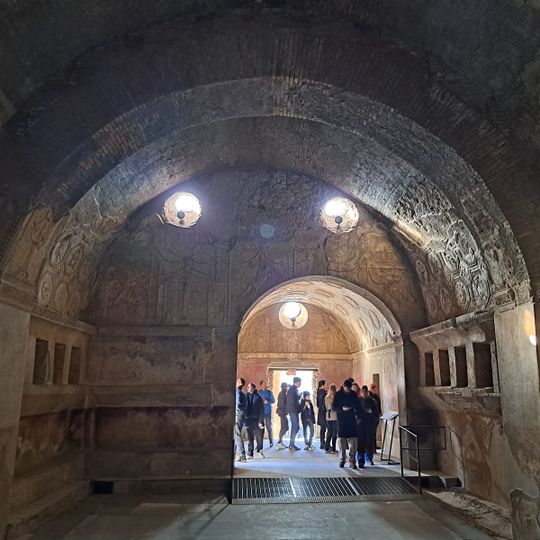
The Stabian Baths are an ancient Roman bathing complex in Pompeii with separate sections for men and women, featuring changing rooms, cold pools, warm chambers, and hot rooms arranged in a linear sequence. The layout allows visitors to understand the path people took as they moved through increasingly heated spaces.
The Stabian Baths were built around the 4th-3rd century BC, making them the oldest building of their kind in Pompeii, on a site that had earlier held a hypogeum tomb. They were greatly enlarged in the 2nd century BC and repeatedly restored, notably after the earthquake of 62 AD, when work was still unfinished at the time of the eruption. An inscription places their peak around 80 BC.
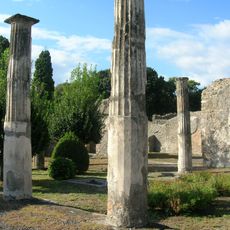
The palaestra's portico stuccoes, in the Fourth Style, show Jupiter seated with a sceptre, Daedalus forging wings for Icarus, and Hylas with the nymphs. Lime and calcite were used because they resist damp. The women's section had no access to the palaestra, which was reserved for men.
An advanced heating system circulated hot air through hollow spaces beneath raised floors and within walls to warm the various areas. Understanding this system helps visitors recognize the purpose and connection between different rooms during their tour.
A circular dry heat room was added during renovations around 80 BC and shows how Romans improved their facilities over time. This room sits apart from the main sequence and reveals that the bathhouse evolved to meet changing preferences across generations.
The community of curious travelers
AroundUs brings together thousands of curated places, local tips, and hidden gems, enriched daily by 92,804 contributors worldwide.