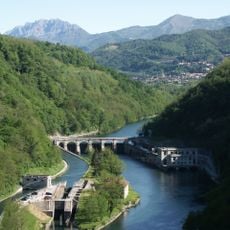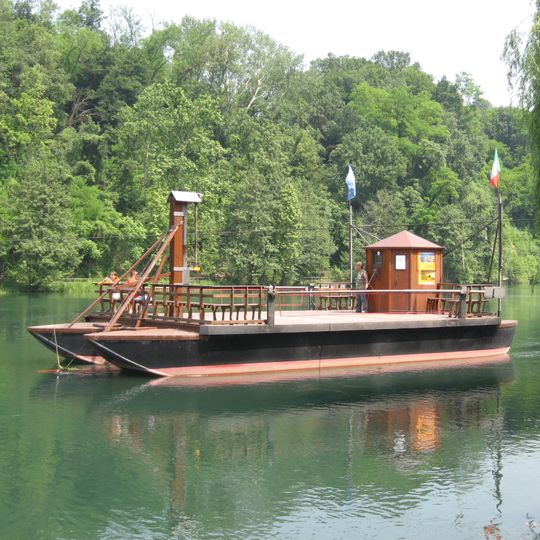
Traghetto di Leonardo, Cable ferry in Villa d'Adda, Italy.
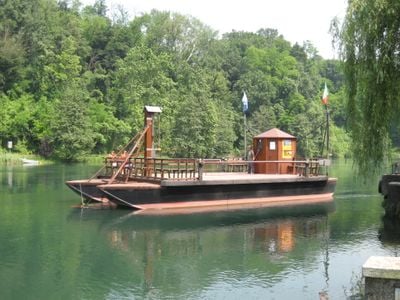
Traghetto di Leonardo is a cable ferry connecting Imbersago and Villa d'Adda across the Adda River through an ingenious cable system. The boat accommodates up to one hundred passengers and five vehicles at once, moving entirely through the force of the river's natural current.
Leonardo studied the ferry in Vaprio d'Adda in 1506–1507; his drawing dated 1513 is in the Windsor Code. Tommaso Landriani bought the Imbersago crossing in 1512, and the rope ferry still in use was inaugurated in 1678 under Count Alberico Barbiano di Belgioioso. A replica built by Venetian shipwrights replaced it on 22 May 1994.
The ferry's name comes from Leonardo da Vinci, who studied the crossing during his stay at Vaprio d'Adda in 1506-1507; his drawing of the "porto della Canonica di Vaprio", dated 1513, is kept in the Windsor Code in England. The service passed from the Landriani, who bought the port in 1512, to the Barbiano di Belgioioso and later the Castelbarco, who granted the ferryman Pietro Magni the only fishing licence.
The ferry carries up to 100 people and 5 cars on a 60 m² deck and is operated by a single person. Board at the Imbersago or Villa d'Adda dock; the operator uses a rudder and an iron pole on the steel cable to start the crossing. The trip takes a few minutes and runs on the river current alone.
The ferry is held by a steel cable stretched between the two banks and moves by the force of the current alone, with no engine. A single operator steers with a rudder and gives the initial push by acting on the cable with an iron bar; once the hulls sit at an angle, the current carries the crossing. In the 1950s Costante Magni inserted a disc between the two rollers so the cable could no longer slide vertically and injure someone.
The community of curious travelers
AroundUs brings together thousands of curated places, local tips, and hidden gems, enriched daily by 92,811 contributors worldwide.