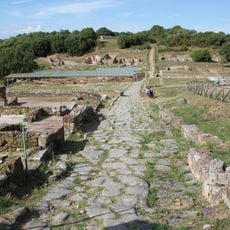
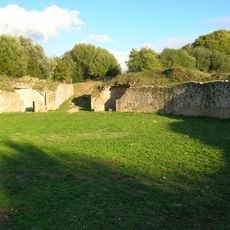
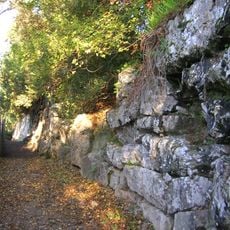
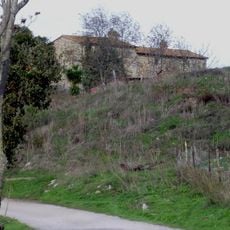
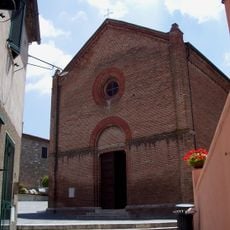
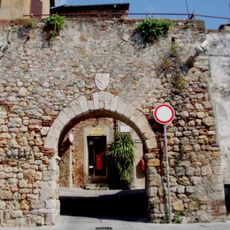
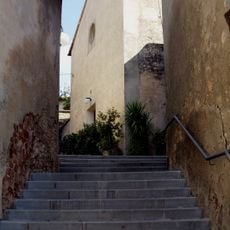
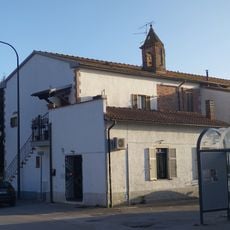
Tino di Moscona, Medieval fortification in Poggio di Moscona, Grosseto, Italy.
Tino di Moscona is a circular stone fortification on the summit of the hill of the same name, the first to rise northeast of Grosseto, above the Etruscan-Roman site of Roselle. Two separate entrance gates open through the wall circuit; inside are a well-preserved underground chamber, the remains of a Roman cistern and, on the east side, traces of a medieval settlement.
The site was occupied in the Villanovan period, then probably by Etruscans and Romans, whose water cistern survives. In the Middle Ages a circular wall and adjoining buildings were raised as a strategic work after repeated barbarian invasions struck Roselle below. Medieval documents record an Aldobrandeschi plan to rebuild Grosseto here after Roselle was abandoned; it failed when Siena took the fortified settlement. After that siege the site was gradually abandoned until restorations completed in 2005.
Villanovan burials found around the walls contained jewellery kept inside cinerary vases, the oldest traces of use of the hill. The site was then occupied by the Etruscans and later by the Romans, who left a water cistern. Medieval documents record a plan, studied by the Aldobrandeschi, to rebuild Grosseto here after Roselle was abandoned.
The ruins stand on the summit of the hill north-east of Grosseto, above the archaeological area of Roselle; the climb is on foot and the terrain is uneven. Restoration work ended in 2005, so the walls, the underground chamber and the Roman cistern can be examined. Check locally before setting out, as access arrangements are not fixed.
The hilltop also preserves traces of a Villanovan settlement: goldwork objects were found inside cinerary vases around the fortification. These finds predate the Etruscan and Roman use of the site, shown by a Roman water cistern. The medieval walls were restored in 2005.
The community of curious travelers
AroundUs brings together thousands of curated places, local tips, and hidden gems, enriched daily by 94,571 contributors worldwide.