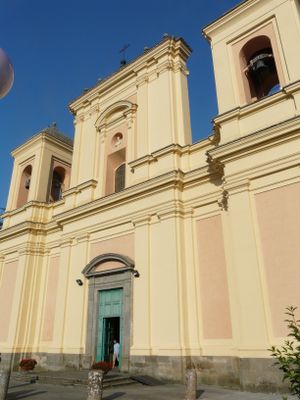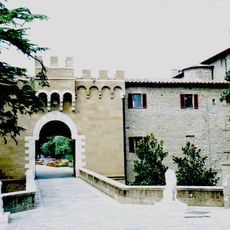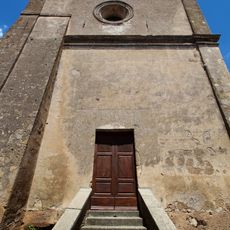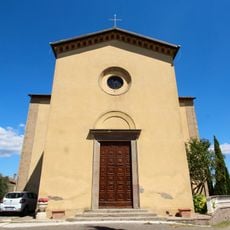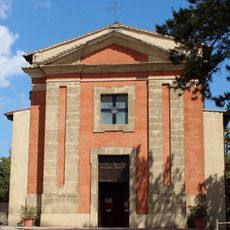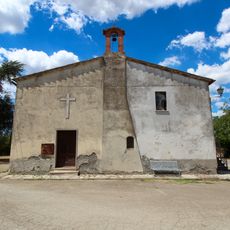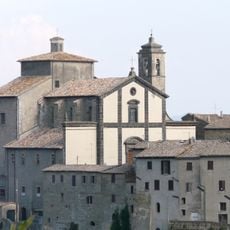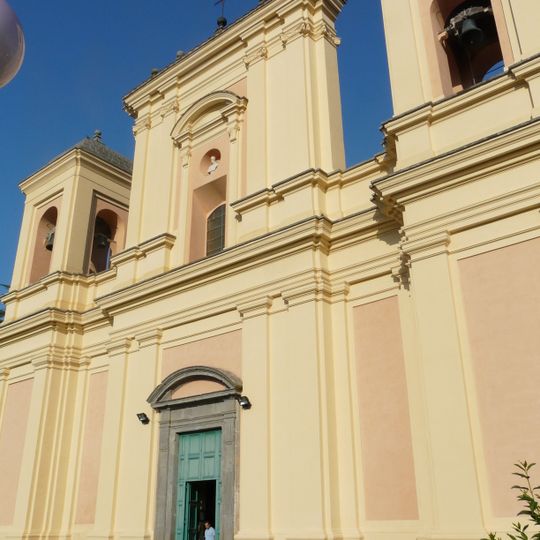
Acquapendente Cathedral, Minor basilica and co-cathedral in Acquapendente, Italy.
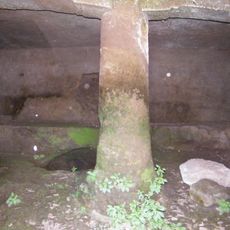
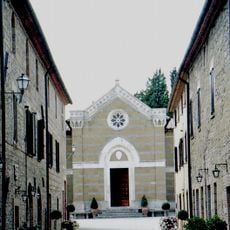
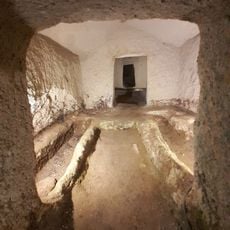
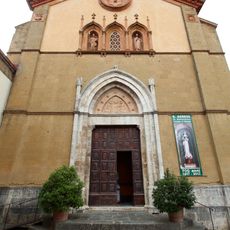
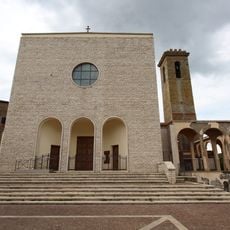
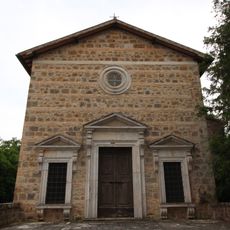
Acquapendente Cathedral began as a Romanesque church of the 12th century, its original structure now overlaid with later painted terracotta and stucco work, including a Neoclassical west front. Beneath it lies a crypt from the second half of the 10th century, older than the church above, whose pillars divide the space into nine small aisles and carry carved zoomorphic capitals.
The building began as the church of a former Benedictine monastery, and the present Romanesque structure dates from the 12th century. In 1649 it became a cathedral as the seat of the new Diocese of Acquapendente, created in succession to the suppressed Diocese of Castro del Lazio, from whose former cathedral it received treasures, furnishings and the relics of Saint Bernard of Castro. On 27 March 1986 the bishopric was united with several others to form the Diocese of Viterbo, in which the church is now a co-cathedral.
The crypt displays carved stone capitals created by medieval craftsmen, revealing the skill and artistic taste of people who worked here centuries ago. These ornamental details show how much care went into decorating even the hidden parts of the church.
You can visit daily to attend services or explore on your own, with guided tours available if you prefer not to walk around alone. Both the main church area and the underground crypt are open to visitors.
The crypt holds a blood-stained stone said to come from the Holy Sepulchre in Jerusalem, the relic that gave the church its dedication. Its 34 vaulted bays rest on 24 columns with carved animal capitals, and the shrine reproduces the Jerusalem church in miniature.
The community of curious travelers
AroundUs brings together thousands of curated places, local tips, and hidden gems, enriched daily by 94,386 contributors worldwide.