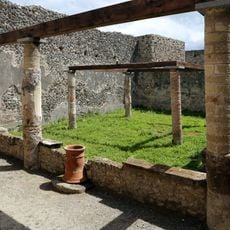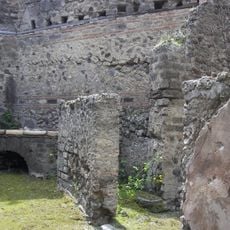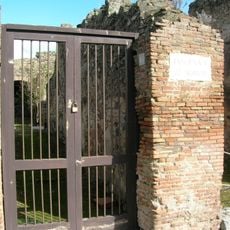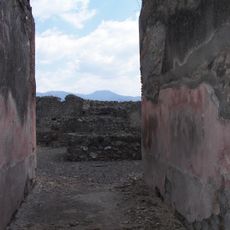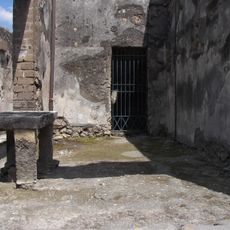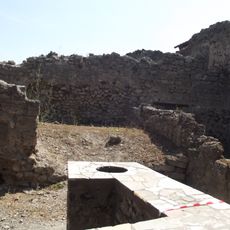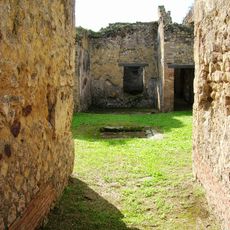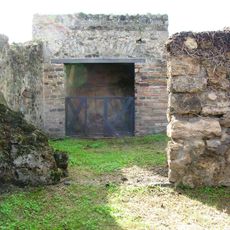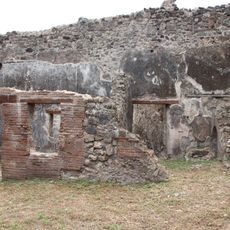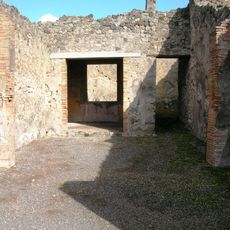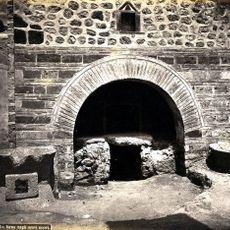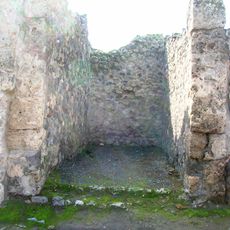
House of M. Lucretius, Ancient Roman residence in Pompeii, Italy.
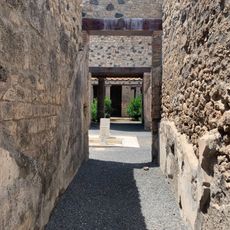
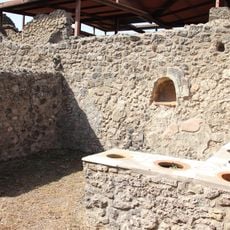
The House of M. Lucretius is a Roman residence organized around a central open courtyard with rooms featuring black wall panels divided by yellow bands. The layout reflects how wealthy households were designed with interconnected spaces and decorated interior surfaces.
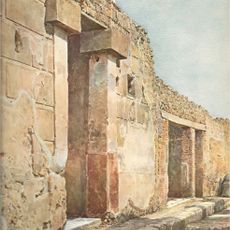
The house was buried under ash and lapilli in the eruption of Vesuvius in 79 and brought to light by excavations between 1846 and 1847. It faces Via Stabiana and covers about 625 square metres. Its name comes from a fresco found in a room overlooking the garden: a small panel showing a writing set with a letter addressed to Marcus Lucretius, decurion of Pompeii and priest of Mars.
The house takes its first name, Casa delle Suonatrici, from a small painting in the entrance showing a group of female musicians; opposite it is a portrait of Ceres. In a room off the garden was found the fresco that gave the house its other name: a writing set with a letter addressed to Marcus Lucretius, decurion of Pompeii and priest of Mars.
The house can be visited as part of the Pompeii archaeological site during standard opening hours. Some original wall paintings from this residence are now displayed at the Archaeological Museum in Naples for better preservation and viewing.
The garden fountain had a statue of Silenus holding a wineskin, and water flowed from it through a short channel into a round basin. The lead pipes and taps were found intact, and the niche behind the fountain was decorated with a mosaic.
The community of curious travelers
AroundUs brings together thousands of curated places, local tips, and hidden gems, enriched daily by 95,043 contributors worldwide.