House of Orpheus, Ancient Roman domus in Pompeii, Italy
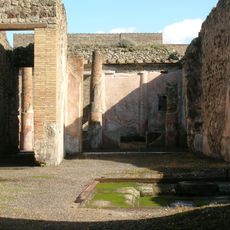
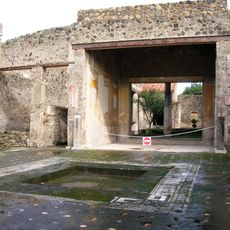
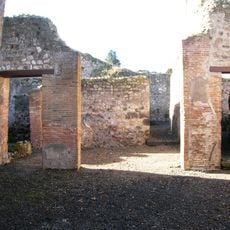
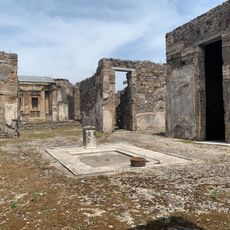
The House of Orpheus (VI 14, 20) is a Roman domus in Pompeii entered through an atrium with a marble impluvium and fountain, its wall stuccoes largely lost to vibrations from Second World War bombings. A tablinum with black-and-white geometric mosaic flooring leads to a peristyle of eight stuccoed columns, fluted in their upper part, set on two sides around a garden. Rooms opening onto the garden include two triclinia and a chamber with a tripartite fresco of Cupid; only the base of the staircase to the collapsed upper floor remains.
The house was buried by the eruption of Vesuvius in 79 AD and brought to light during the Bourbon excavations of 1834, then explored again in 1874. Electoral inscriptions on its outer walls carried the name of its owner, Vesonius Primus, who also owned a neighbouring fullonica (laundry).
The frescoes showing Orpheus on the west wall reveal how Romans incorporated Greek mythology into their homes as a sign of taste and learning. Such images were common in the houses of wealthy families who wanted to display their knowledge.
The house offers several rooms to explore, including decorated corridors near the entrance that still display their original painted surfaces. Visitors should expect uneven floors and tight passages characteristic of ancient Roman domestic spaces.
The dog's cast was made in the atrium, not at the entrance, and it preserved a leather collar with two bronze rings; the original is kept in the Antiquarium of Pompeii. The animal died tied up, unable to escape the ash and lapilli of 79 AD.
The community of curious travelers
AroundUs brings together thousands of curated places, local tips, and hidden gems, enriched daily by 92,994 contributors worldwide.