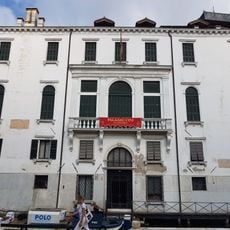
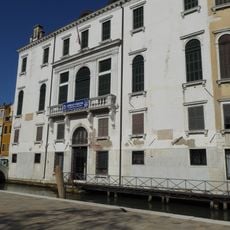
Palazzo Loredan Cini, Renaissance palace in Dorsoduro, Venice, Italy
Palazzo Loredan Cini is a palace in Dorsoduro formed by merging the former Palazzo Foscari-Loredan with the adjacent Palazzo Grimani. Its narrow Grand Canal facade has no entrance and once bore frescoes by Giuseppe Porta, now lost. The 50-metre facade on Rio San Vio is divided into two sections, each with its own house number, and connects to campo San Vio by a private bridge.
The Foscari palace, also called Loredan, stood on Giustinian land from the 14th-15th centuries; in 1428 the Republic bought it for 6,500 ducats, and it passed through the Marquis of Mantua, Francesco Sforza and, by public auction, Doge Francesco Foscari. The Foscari rebuilt it in the mid-1560s under Elisabetta Venier Foscari. The adjoining Grimani palace was built 1564-1567 for Vincenzo Grimani; in 1920 Vittorio Cini bought the Foscari palace and merged the two.
The palace is named after the Loredan, its founding family, and later passed to the Caldogno and Valmarana. Since 1984 part of it has housed the Galleria di Palazzo Cini, where Yana Cini Alliata di Montereale donated her father Vittorio's collection so the works stay in their original setting. The first floor displays Ferrarese paintings, including Cosmè Tura's St George from the Colonna altarpiece.
The palace stands between Palazzo Balbi Valier and the Rio San Vio in Dorsoduro. Its narrow Grand Canal front has no entrance; the northern facade on the Rio has a single water door and a private footbridge linking it to campo San Vio. Approach on foot from campo San Vio to see the two facades.
During the Austrian occupation, the building housed Croatian soldiers before later becoming an educational center. This military phase left few visible marks, but reveals how Venice housed foreign troops during its time under outside rule.
The community of curious travelers
AroundUs brings together thousands of curated places, local tips, and hidden gems, enriched daily by 93,923 contributors worldwide.