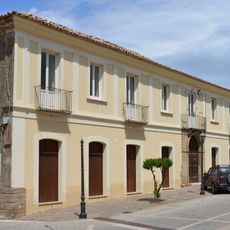
Borgia Castle, Medieval castle in Squillace, Italy
The Castello di Squillace, known as the Borgia Castle, is a stone fortress whose oldest core is a rectangular Norman keep measuring 10 by 11.5 metres. Its lower level served as a cistern, the first floor held the main entrance and assembly rooms, and the second floor a private hall. A marble coat of arms of the Borgia family sits above the entrance portal.
The castle was built in 1044 by Normans William Iron Arm and Guaimar IV of Salerno on the site of Cassiodorus's monastery, which the Byzantines had turned into a kastron. It passed through the Lancia, Montfort, Del Balzo and Marzano families from 1256 to 1485, then to the Borgias, whose marble coat of arms was placed on the portal after 1494. The 1783 earthquake damaged it.
The name "Borgia Castle" comes from the family that held Squillace from 1494 until 1729, when the line ended without heirs. The marble coat of arms on the entrance portal was placed after 1494, when Goffredo Borgia married Sancia d'Aragona, sealing the alliance between Pope Alexander VI and Alfonso II of Aragon. The castle is open to the public.
The castle stands in Squillace's historic centre, reachable on foot through the town's streets. Inside, the keep's lower level held a cistern, the main entrance is on the first floor, and a terrace at the top of the rectangular tower gives views over the surrounding territory. Expect stairs and stone floors.
Excavations by the École française in the early 1990s, not 1994 restoration work, brought to light two skeletons from the 13th-14th centuries, their skulls turned toward each other and hands clasped. Studies suggest one was a man about 1.70 m tall and the other a woman of 1.68 m, possibly of northern origin from the Norman period; other theories propose two brothers or two warriors, one Swabian and one Angevin.
The community of curious travelers
AroundUs brings together thousands of curated places, local tips, and hidden gems, enriched daily by 94,586 contributors worldwide.