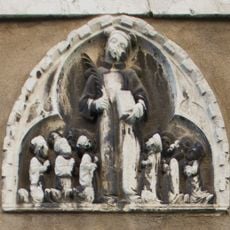
Palazzo Loredan in Campo Santo Stefano, Gothic palace in Campo Santo Stefano, Italy.
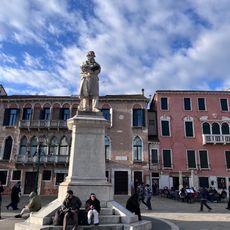
Palazzo Loredan in Campo Santo Stefano is a palace in the San Marco district of Venice, overlooking Campo Santo Stefano. Its long side has a polifora of eight windows on nine Corinthian columns, while the smaller facade toward the church of Santo Stefano is a stone front by Giovanni Gerolamo Grapiglia. Inside, a large entrance hall with a double staircase by Antonio Abbondi leads to the piano nobile.
Before the Loredan family bought it in 1536, the site was a group of Gothic buildings belonging to the Mocenigo family; the architect Antonio Abbondi merged and rebuilt them into a single patrician residence. After the fall of the Republic, an heir sold the palace to a businessman around 1802–1805. In 1813 it passed to the Royal Treasury and housed the Ministry of War with its military court and the Governor's residence; from 1855 to 1862 the south wing was converted to offices with a mezzanine on the piano nobile. In 1888 it was assigned to the Istituto Veneto di Scienze, Lettere ed Arti, which moved in in 1891.
The palace is named after the Loredan family, who bought the Gothic buildings of the Mocenigo family in 1536 and had Antonio Abbondi combine them into one residence. Frescoes by Giuseppe Porta, called Salviati, on the long facade showed Roman figures such as Lucrezia, Clelia, Porsenna and Muzio Scevola, claimed as the family's ancestor.
The palace is the seat of the Istituto Veneto di Scienze, Lettere ed Arti, which moved in in 1891, so access is tied to the institute's activities rather than to tourist visits. The Panteon Veneto busts and medallions are displayed in the entrance hall. The long front runs along Campo Santo Stefano, while the smaller, richer facade faces the church of Santo Stefano.
The Panteon Veneto, a collection of busts and medallions of distinguished Venetians begun in 1847, is displayed in the entrance hall. Removed from the Doge's Palace in 1955 and kept at Ca' Pesaro, it arrived here in 1989; the last bust added, in 1931, was that of Carlo Gozzi.
The community of curious travelers
AroundUs brings together thousands of curated places, local tips, and hidden gems, enriched daily by 94,534 contributors worldwide.