Castle of Casale Monferrato, Hexagonal military castle in Casale Monferrato, Italy
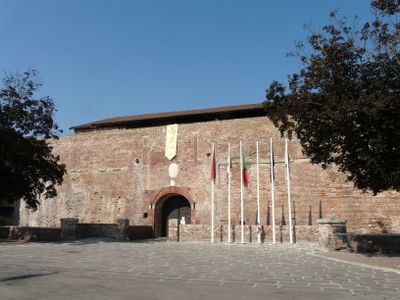
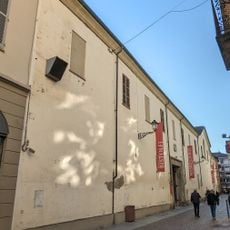
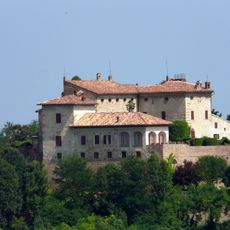
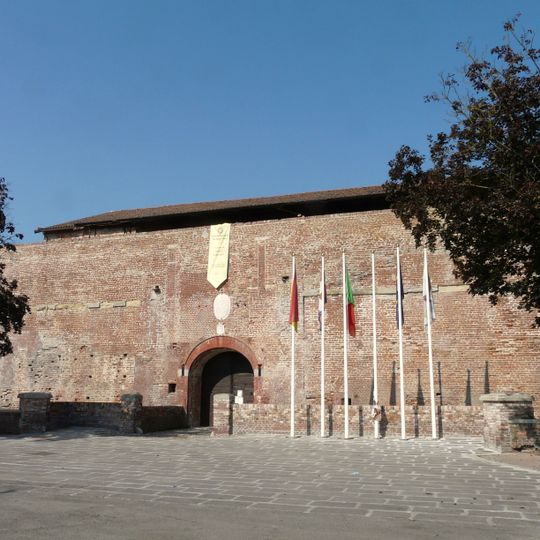
The Castle of Casale Monferrato, known as the Castello dei Paleologi, is an asymmetrical hexagonal fortress with circular corner towers, surrounded by a deep dry moat. Its main gate bears a marble bas-relief with the coats of arms of the lords of Monferrato: Aleramo, the Paleologi and the Gonzaga. Visitors can walk the patrol paths and explore the western wing's underground chambers, rebuilt in the 18th century.
Giovanni II Paleologo built the castle in 1352 to strengthen the fortifications already standing at Casale Monferrato. Under the Visconti it was equipped with firearms, and in the 15th century Guglielmo VIII Paleologo and Bonifacio V enlarged and transformed it. After the Peace of Cateau-Cambrésis of 1559 the city passed to the Gonzaga of Mantua, who turned the former residence back into a fortress, reinforcing flanks and towers and adding ravelins; demolition of the ravelins began in 1856.
The castle does not give its name to the city; Casale Monferrato's name predates it. Since 1856 part of the structure was demolished for new urban space, and today the remaining castle serves as a cultural venue for the city, hosting exhibitions and events in its halls and along the visitable patrol walkways.
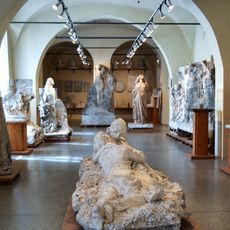
The castle is open to visitors and houses exhibitions on local history spread across several rooms. It is worth setting aside enough time to visit both the interior halls and climb at least one of the towers for a broader view of the site.
The marble bas-relief over the main gate carries the coats of arms of three ruling houses of Monferrato: Aleramo, the Paleologi and the Gonzaga. It marks the castle as a symbol of seigneurial power. Below ground, the western wing's cellars were rebuilt in the 18th century and can be visited along with the patrol walkways.
The community of curious travelers
AroundUs brings together thousands of curated places, local tips, and hidden gems, enriched daily by 93,794 contributors worldwide.