San Leucio, Archaeological site in Canosa di Puglia, Italy
San Leucio is a ruined sixth-century church in Canosa di Puglia, built by Bishop Sabino on the foundations of a Hellenistic temple. Its plan is a double tetraconch: an outer square with four semicircular apses, an inner square of four columns, and a four-armed ambulatory with barrel vaults. The floors carry geometric mosaics, including pebble work reused from the temple.
A Hellenistic temple with an Etruscan-Italic plan stood here from the late 4th to the first half of the 3rd century BC, built on a high podium with central stairs and flanked by two large telamons. After the pagan building was abandoned, Bishop Sabino had a church dedicated to Saints Cosmas and Damian built on its foundations in the 6th century, reusing its materials. Damaged probably by an earthquake and rebuilt within the same century with buttresses and a dome, it was rededicated to Saint Leucio in the 8th century, after his relics were moved from Brindisi to Trani.
The name comes from Saint Leucius, to whom the church was rededicated in the 8th century after his relics were moved from Brindisi to Trani and his cult spread here. In the western apse, a raised presbytery with a large altar under a ciborium carries mosaics of paired peacocks flanking a flower on a great acanthus basket, a paradise motif framed by a braid pattern.
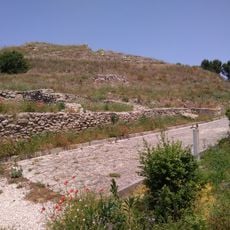
Access is through guided tours that explain the architectural elements and historical context of the structures. Wear comfortable shoes and prepare for uneven ground, as this is an active excavation site with exposed foundations and pathways.
The north arm of the ambulatory keeps a floor of river cobbles, probably a repair of the paving of the earlier Hellenistic temple rather than a new mosaic. Look for it just to the right of the entrance stairway in the eastern apse.
The community of curious travelers
AroundUs brings together thousands of curated places, local tips, and hidden gems, enriched daily by 93,972 contributors worldwide.