Monticelli d’Ongina Castle, Medieval castle in Monticelli d'Ongina, Italy
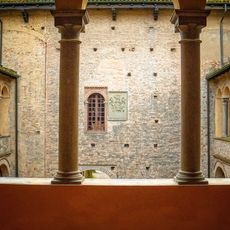
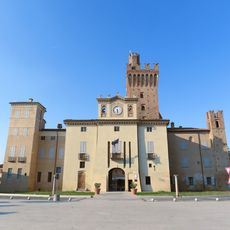
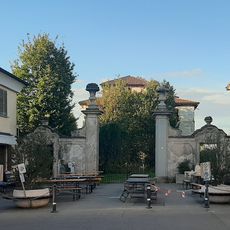
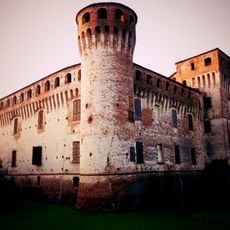
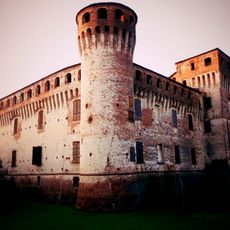
Monticelli d'Ongina Castle, also called Rocca Pallavicino-Casali, is built entirely of brick on a quadrangular plan around an inner courtyard, with four cylindrical towers projecting from the corners above the curtain walls. The west and east entrances are protected by keeps that still show the bolt marks of the drawbridges, now replaced by masonry bridges. The castle cellars house the Po Aquarium and Ethnographic Museum, the Peasant Museum and the Archaeological Museum.
The castle was first mentioned in 1298, when Cremona fortified the village to control the Po. The present structure was begun by Rolando Pallavicino in the early 15th century and completed by his son Carlo, bishop of Lodi. Through Livia Pallavicino it passed to the Casali of Bologna, who sold it in 1957 to the parish of San Lorenzo Martire.
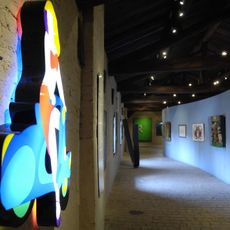
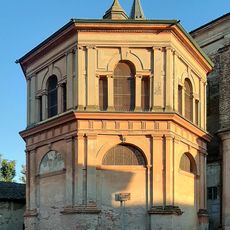
The palace chapel was commissioned by Carlo Pallavicino, bishop of Lodi, for his private prayer, and Benedetto and Bonifacio Bembo painted its frescoes with scenes from the Gospels and episodes from the life of Saint Bassianus, patron of Lodi. The noble halls, now used for painting and photography exhibitions, carry frescoes of the glory of the Casali family and allegories of the seasons.
The castle stands in the historic centre of Monticelli d'Ongina, between Cremona and Piacenza. The two entrances, on the west and east sides, are reached by masonry bridges that replaced the drawbridges; the bolt marks of the old bridges are still visible on the keeps. The basement houses the Po museums and aquarium.
In the upper floor of the eastern keep are rooms once used as a prison, and the graffiti left by prisoners can still be seen on the walls. The castle also houses the Po Aquarium and Ethnographic Museum, the Peasant Museum and the Archaeological Museum in its cellars.
The community of curious travelers
AroundUs brings together thousands of curated places, local tips, and hidden gems, enriched daily by 94,219 contributors worldwide.