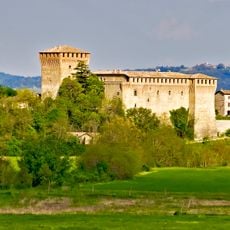
Santa Maria Assunta, Romanesque church in Fornovo di Taro, Italy.
Santa Maria Assunta is a three-nave Romanesque church in Fornovo di Taro, entered from the west through a narthex and ending in three apses to the east. Its stone facade has a central portal flanked by two 13th-century pilasters with carved capitals, a niche holding a headless Romanesque statue of a pilgrim, two biforas and a cross-shaped opening. A bell tower stands to the left.
A church is documented here on 24 August 854, when the ecclesia Sancte Marie sita Fornovo was named in a territorial dispute settled by the bishop of Piacenza. Around the mid-11th century the building was rebuilt with three naves and three apses. Between 1303 and 1375 the bell tower was partly rebuilt, and in 1578 the carved ambon was dismantled after the Council of Trent.
The church was a pieve, a baptismal mother church with jurisdiction over eighteen surrounding chapels by 1230, from Medesano to Solignano. Its name comes from the pieve di Fornovo, and the 11th-century carved pulpit was dismantled in 1578 after the Council of Trent; its sculptures were reused in the church and in Santa Maria Assunta at Bardone.
The church is generally open during religious services and welcomes visitors interested in viewing the medieval architecture and stone details. It helps to check opening times in advance or ask locals to ensure access when you visit.
A piece of a carved stone pulpit from the 11th century is built into the facade, showing how older structures were incorporated into the building. This fragment reveals how medieval churches reused materials and gave new purpose to older elements.
The community of curious travelers
AroundUs brings together thousands of curated places, local tips, and hidden gems, enriched daily by 94,540 contributors worldwide.