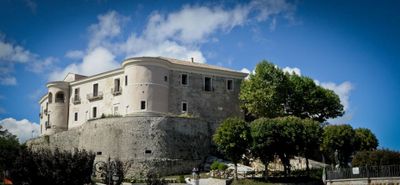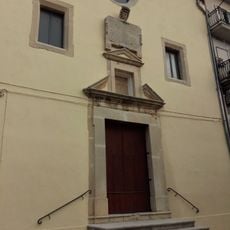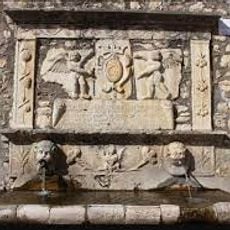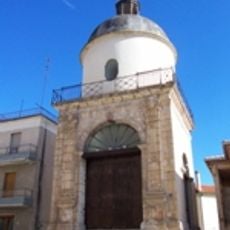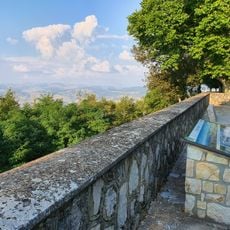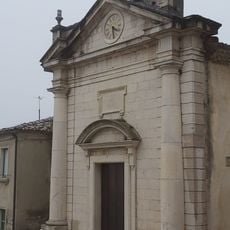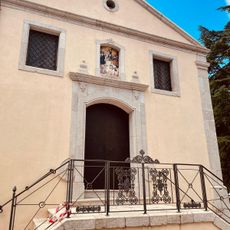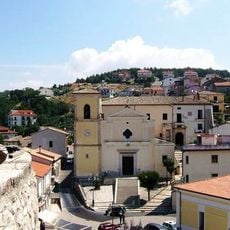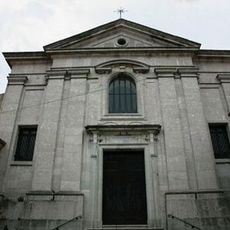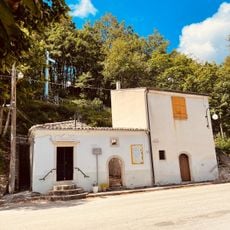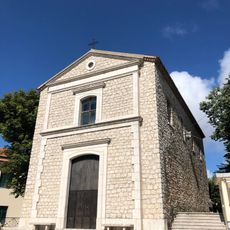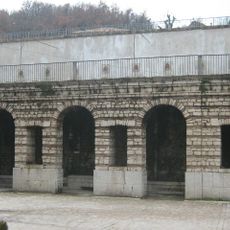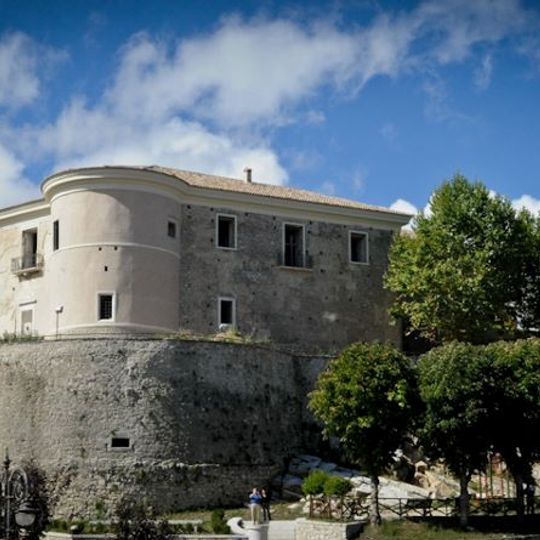
Castle of Gesualdo, Renaissance castle in Gesualdo, Italy.
The Castle of Gesualdo is a fortress ringed by four circular towers with curtain walls and ravelins around a central courtyard. Its facade follows 19th-century architectural schemes, while the interior keeps Gothic art traces and Renaissance elements. Carlo Gesualdo rebuilt it at the end of the 16th century as a Renaissance court, adding structures such as a theatre.
The castle's origins are debated: one tradition credits Lombard duke Romualdo of Benevento with founding it in the 7th century, another prince Radelchi I in the 9th. The first records date to Norman rule in the 12th century, when Guglielmo d'Altavilla held it; his family kept the fief for five centuries. Carlo Gesualdo transformed it into a Renaissance court at the end of the 16th century, and the Caccese family rebuilt parts after 1855.
The castle served as the home of composer Carlo Gesualdo and shaped the town's character as the residence of a noble family. It reflects how fortifications transformed into comfortable homes for the nobility during the Renaissance.
The castle has been only partially open to the public since December 2015, and restoration work begun in 2000 is still unfinished, so some areas may be closed off. It stands in the centre of Gesualdo, about 90 km from Naples and 290 km from Rome, and is linked to piazza Neviera by the 19th-century Caccese alterations.
Carlo Gesualdo used the castle rooms to compose groundbreaking music that was far ahead of its time. These musical experiments took place within the chambers, leaving the residence as a setting for an unusual artistic innovation.
The community of curious travelers
AroundUs brings together thousands of curated places, local tips, and hidden gems, enriched daily by 93,582 contributors worldwide.