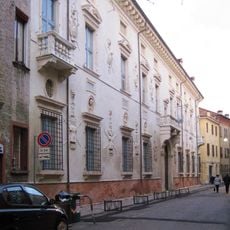
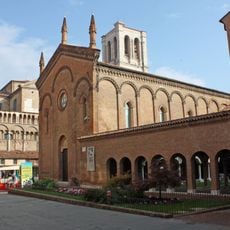
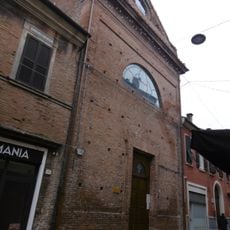
Palazzo Paradiso, Renaissance palace in medieval center of Ferrara, Italy
Palazzo Paradiso stands at Via Scienze 17 in the medieval centre of Ferrara, next to the former Jewish ghetto. Alberto V d'Este built it in 1391; of its three original loggias only one survives. Giovanni Battista Aleotti added a second floor and moved the facade to Via Scienze, where the portal carries a small clock tower designed in 1610 by Alessandro Balbi and Aleotti. It houses the Ariostea library, the Sala Ariosto and an anatomical theatre.
The palace was commissioned at the end of the 1300s by a member of the Este family as a residential palace during Ferrara's height as a Renaissance power. Over the centuries, the building was transformed to serve educational purposes and now houses one of the region's major libraries.
The Biblioteca Ariostea, founded in 1750 and refurbished in 1801, is dedicated to manuscripts and publications by local writers such as Ariosto, Tasso, Monti, Govoni, Caretti and Quilici. Its collection holds nearly 400,000 items, and the restored reading room is named after the bibliophile Giovanni Maria Riminaldi.
The palace stands at Via Scienze 17, beside the former Jewish ghetto. The university faculties left in 1963, but the Ariostea library still occupies the building, and the Anatomical Theater and Sala Ariosto can be visited inside. The reading room is named after the bibliophile Giovanni Maria Riminaldi.
Inside the palace there is an octagonal anatomical theater from the 1700s with specially designed stairs for medical demonstrations and teaching. This room reveals how medical students learned in the past and represents a rare example of specialized academic architecture from that era.
The community of curious travelers
AroundUs brings together thousands of curated places, local tips, and hidden gems, enriched daily by 94,375 contributors worldwide.