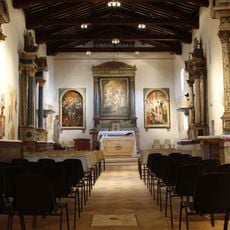
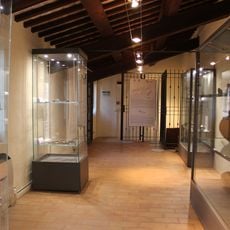
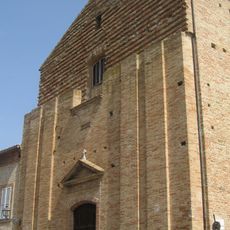
Area archeologica La Cuma, Roman sanctuary ruins in Monte Rinaldo, Italy.
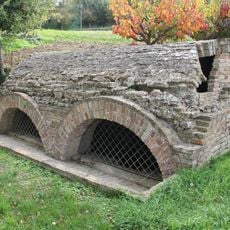
Area archeologica La Cuma is a Hellenistic sanctuary on the western slope of a hill in Monte Rinaldo, built on artificial terraces. It consists of a large portico with two rows of columns, an inner Ionic and an outer Doric, a temple preserved only at foundation level with a three-part podium, and a third structure between them containing five rooms, one interpreted as a basin.
The monumental terraces visible today date to the 2nd century BC, built under Roman rule, likely funded by wealth from the newly created province of Asia. Tufa blocks and columns came to light in 1957 during farm work; excavations began in 1958 and the area was placed under archaeological protection between 1958 and 1960. Early excavators linked the site to Novana, the Picene city mentioned by Pliny the Elder, but finds did not confirm this.
The deity worshipped here is uncertain: a ceramic fragment bearing the name of Jupiter may be a maker's mark rather than a votive inscription. Some scholars propose a female deity comparable to Cupra, venerated by the Picenes. The presence of a well and a basin suggests rites linked to healing waters, a common feature of Hellenistic central Italy.
The site sits on elevated terrain and requires some walking to explore fully. It helps to visit the nearby museum first to understand the history and discoveries before seeing the remains on location.
The temple survives only at foundation level, with a three-part podium that some scholars link to the proportions Vitruvius gives for the Tuscan temple, as at Temple A of Pyrgi. The link is a hypothesis, not a certainty. The site was first reported in 1953, but large tufa blocks and columns came to light in 1957 during farm work.
The community of curious travelers
AroundUs brings together thousands of curated places, local tips, and hidden gems, enriched daily by 93,387 contributors worldwide.