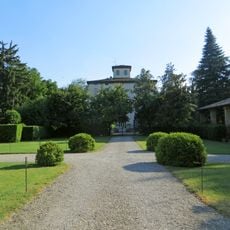
Villa Magnani, Baroque revival villa in Mamiano, Traversetolo, Italy
Villa Magnani is a neo-baroque residence rebuilt in 1904 by architect Antonio Citterio for Count Enrico Zileri-Dal Verme. Its three-storey south facade has a central staircase, a broken triangular pediment and three round arches on Doric stone columns; the raised central bay recalls the 17th-century turret. Two single-storey wings added in 1967 flank the main block.
The original building was constructed in the 17th century for the Sforza di Santafiora counts, with documented records dating back to 1632. Over subsequent centuries, the residence changed hands several times before becoming an art museum.
The Magnani-Rocca Foundation, legally established in 1977 with the Cassa di Risparmio di Parma, first showed its contemporary art collection in the orangery in 1983. It holds the most important collection of Giorgio Morandi, alongside works by Monet, Renoir, Cézanne, Goya, Titian, Dürer, De Chirico, Rubens, Van Dyck, Filippo Lippi, Carpaccio, Burri, De Pisis, Tiepolo and Canova.
The main entrance is now on the west side, next to the ticket office and the chapel of the Assunta; the historic entrance lies to the north at the end of a long avenue of cypress poplars, with two secondary gates on the other sides. The former farm buildings east of the villa, around a rectangular courtyard, now hold a restaurant and bar. The villa stands in the north-west corner of the walled, roughly trapezoidal park.
The park's southern hill holds a former farm building converted in the late 19th century into a small neo-Gothic castle, built as a romantic backdrop to the estate. The 12-hectare grounds also contain an artificial grotto and a lake created for the Paolucci marquises.
The community of curious travelers
AroundUs brings together thousands of curated places, local tips, and hidden gems, enriched daily by 94,661 contributors worldwide.