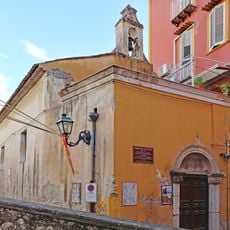
Campanile del duomo di Gaeta, Romanesque bell tower at Pope Gelasius Square, Italy.
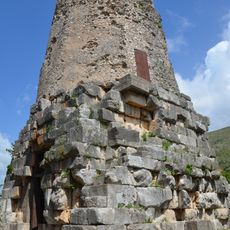
The Campanile del Duomo di Gaeta is a 57-metre Romanesque bell tower with strong Arab-Norman influence, built from 1148 and crowned in 1279 by an apical lantern. It stands behind the cathedral between piazza papa Gelasio, facing the gulf, and piazza Cavallo, the ancient forum. Its hollow base once served as the monumental entrance to the church, and the arch between its two internal bays bears the name of the architect Nicolangelus Romanus.
Construction of the tower began in 1148 under the architect Nicolangelus Romanus and was completed in 1279 while Bishop Bartolomeo Maltacea oversaw the final phases. This extended construction period reflects the region's complex medieval history and changing circumstances over more than a century.
A Latin plaque inside the small top turret records that Bishop Bartolomeo Maltacea had it finished in 1279; it was originally set at the tower's entrance. In the 15th century two Roman sarcophagi and pieces of the cathedral's old ambo were placed along the base walls. The 18th-century clock dial by Domenico Antonio Vaccaro is now kept in the Diocesan Museum.
The tower reopened to visitors following major restoration work that improved structural integrity and access throughout the building. Visitors should wear sturdy footwear and prepare for steep internal stairs when climbing to the upper levels.
The base was built hollow so it could serve as a monumental entrance to the cathedral behind it, a role it kept until the church was rebuilt after the June 1213 earthquake and its orientation reversed. The architect's name, magister Nicolangelus Romanus, is carved on the keystone of the pointed arch between the base's two internal bays.
The community of curious travelers
AroundUs brings together thousands of curated places, local tips, and hidden gems, enriched daily by 93,400 contributors worldwide.