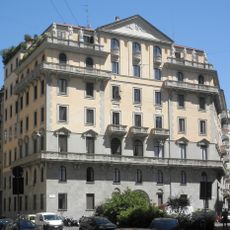
Palazzo della società Buonarroti-Carpaccio-Giotto, Italian national heritage palace in Milan, Italy.
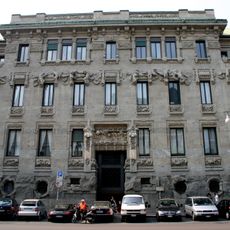
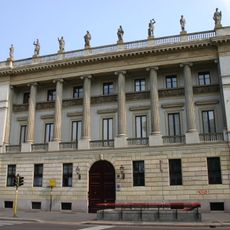
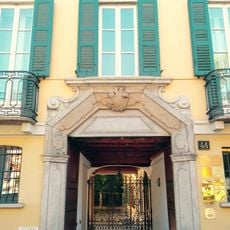
Palazzo della società Buonarroti-Carpaccio-Giotto is a seven-story residential building on corso Venezia, facing the Indro Montanelli public gardens. Piero Portaluppi designed it between 1926 and 1930 with a U-shaped plan around two symmetrical, opposed wings. A large round arch marks the entrance to a covered passage running through the interior. The ground floor holds shops, the first floor offices, the upper floors luxury flats, and a broad terrace tops the building. The facade has pilasters and framed panels, with Doric columns, cornices and statues on the outer walls.
The building was commissioned by the Società Buonarroti-Carpaccio-Giotto, the company that gave the palazzo its name, and designed by architect Piero Portaluppi (1888-1967). It was built between 1926 and 1930 on corso Venezia, facing the Indro Montanelli public gardens in central Milan. Its style mixes Secessionist and Art Deco elements.
The name comes from the Società Buonarroti-Carpaccio-Giotto, the company that commissioned the building, which took its name from three great figures of Italian art: Michelangelo Buonarroti, Vittore Carpaccio and Giotto. The ground floor houses commercial activities, the first floor offices and the upper floors luxury residences, so the building is still used as originally intended.
The building stands on corso Venezia, facing the Indro Montanelli public gardens. Its U-shaped plan is organised around two symmetrical, opposed wings, and a large round arch on the facade opens onto a covered passage that crosses the interior. Shops occupy the ground floor, offices the first floor and flats the upper levels, up to a broad terrace on the seventh floor.
The building takes its name from the Società Buonarroti-Carpaccio-Giotto, the company that commissioned it, which named itself after three Tuscan and Venetian painters: Michelangelo Buonarroti, Vittore Carpaccio and Giotto di Bondone. A covered passage runs through the interior beneath the large round arch, linking corso Venezia with the street behind.
The community of curious travelers
AroundUs brings together thousands of curated places, local tips, and hidden gems, enriched daily by 93,819 contributors worldwide.