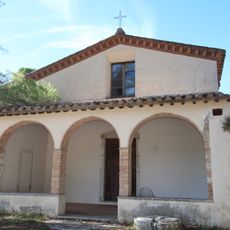
Santa Maria Assunta, Romanesque church in Lugnano in Teverina, Italy.
Santa Maria Assunta is a Romanesque church in Lugnano in Teverina with a limestone facade featuring a large rose window flanked by two griffins on ram heads and a portico with five low arches showing the symbols of the four evangelists. The interior has three naves separated by columns, a raised presbytery, and a semicircular apse. The crypt beneath the presbytery is divided by Corinthian columns into small naves covered with travertine slabs.
A pieve probably stood here in the 8th–9th centuries; the church was rebuilt between the 11th and 12th centuries and finished by 1230 with the portico. Side chapels were added in the 16th century, the apse reworked in the 18th, and in 1937 the chapels were removed and the apse rebuilt to recall the medieval form.
The floor is a 16th-century recomposition in Cosmatesque style, though it lacks the characteristic elements of that school. At the entrance lies an asymmetric quincunx as wide as the nave, similar in size to the floor of Santa Cosma in Anagni from the first half of the 13th century. A row of small guilloche discs follows, then a second quincunx, with triangular motifs in the outer panels.
The raised presbytery is reached by two staircases at the end of the side aisles; the central part gives access to the old crypt. The crypt interior is divided into small naves by Corinthian columns supporting a travertine slab ceiling. The 1937 restoration removed the side chapels and rebuilt the apse.
The eagle on the roof ridge grips a lamb in its talons, a reference to Christ's martyrdom on the cross; the motif recurs on many Romanesque churches dedicated to the Virgin. The small rose window below is framed by seven circular porcelain tiles, a detail easily missed from street level.
The community of curious travelers
AroundUs brings together thousands of curated places, local tips, and hidden gems, enriched daily by 94,531 contributors worldwide.