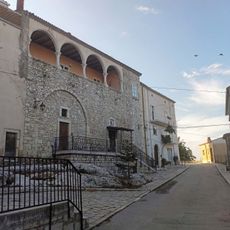
Civitacampomarano Castle, Medieval castle and history museum in Civitacampomarano, Italy.
The castle of Civitacampomarano has a quadrangular plan with three cylindrical towers at its corners; two are intact, while the third was rebuilt during restoration. A moat, now filled with greenery, faces Piazza Municipio. The eastern facade bears the coat of arms of Paolo di Sangro with a griffin and two inverted lilies, flanked by arrow slits showing grooves cut by the drawbridge chains.
The castle replaced a watchtower probably built in the second half of the 12th century, whose perimeter emerged during restoration at the end of the 19th century. Scholars date the present building to the 13th century, under Angevin rule. It was declared a national monument on 2 May 1979 and bought by the State in March 1988.
The coat of arms on the eastern facade is that of Paolo di Sangro: a griffin with two inverted lilies, the griffin standing for the Aragonese and the lilies for the defeated Angevins in the Kingdom of Naples. Some scholars read the inverted lilies as a memory of di Sangro's own betrayal of the Angevins. Above it sits the blazon of the Carafa della Spina, three horizontal bands crossed by a thorn.
The visit runs through the courtyard, the service rooms and stables, and the noble floor reached by a covered stone staircase. The enfilade of rooms on the first floor ends at the north-east tower. The castle was closed for a long restoration between the late 1990s and the early 2000s, and since 2014 it has been managed by the Molise museum authority.
The castle preserves a sophisticated water collection system with terracotta gutters leading to an underground cistern holding 120,000 liters. This engineering feat once supplied water to the entire town and reveals thoughtful planning in the fortress design.
The community of curious travelers
AroundUs brings together thousands of curated places, local tips, and hidden gems, enriched daily by 95,220 contributors worldwide.