Ponte di Oleggio, Iron and masonry bridge in Oleggio, Italy
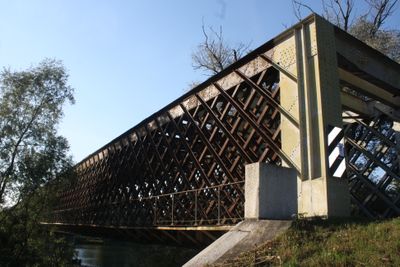
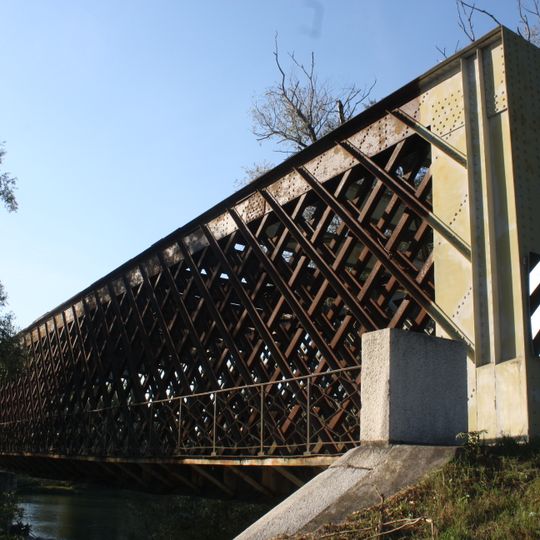
The Ponte di Oleggio is a 187.5-metre iron truss bridge over the Ticino between Oleggio and Lonate Pozzolo, built 1887–1889. Its eight simple lattice spans, reinforced by thin flange plates, rest on piers; pedestrian walkways cantilever outside the truss, bringing the total width to 9 metres. The roadway is 5.33 metres wide and limits vehicles to 4.42 metres in height.
Construction of the bridge was completed in 1889 using modern engineering techniques with iron and masonry materials. The project was part of regional infrastructure development during Italy's modernization period in the late 1800s.
The bridge is crossed by the Strada Statale 527 Bustese, and since its lanes are narrower than modern traffic requires, vehicles pass in alternating single direction. Its pedestrian walkways are cantilevered outside the truss, widening the structure from 6.95 to 9 m. The upper cross beams still carry holes drilled for rail supports, a remnant of the abandoned early 20th-century Gallarate-Oleggio railway plan.
Traffic crosses in a single alternating direction, since the deck is only 5.33 m wide and the bridge was built for lighter volumes. The clearance is 4.42 m, and pedestrian walkways cantilever outside the truss, widening the crossing from 6.95 to 9 m. The bridge carries the SS 527 Bustese between Oleggio and Lonate Pozzolo.
The Ponte di Oleggio is the only surviving example in Italy of a lattice truss structure modelled on American wooden bridges; similar ones stood at Sesto Calende (1882), Turbigo and Malnate (1887). Its upper cross beams still carry holes drilled for anchoring rails, a remnant of the abandoned plan to run a railway over the deck.
The community of curious travelers
AroundUs brings together thousands of curated places, local tips, and hidden gems, enriched daily by 94,101 contributors worldwide.