Santa Margherita Church, Religious building in Settimo Milanese, Italy.
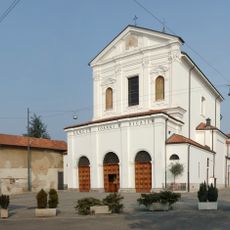
Santa Margherita Church is a brick Romanesque Revival church rebuilt in 1890–1891 to a design by engineer Luigi Bernasconi. Its east-facing facade is divided by four pilasters, with a central portal under a mosaic lunette and a small oculus within a blind rose window. An octagonal lantern rises over the crossing, and the square brick bell tower with a conical spire stands behind the three apses.
A chapel at Settimo is first documented in 1153 and again in the 13th-century Liber Notitiae Sanctorum Mediolani, dependent on the pieve of San Giovanni Battista di Cesano Boscone. Restored and enlarged in 1534 through don Francesco Balbi, the church was in ruins by the 1880s: closed in 1885, it reopened after roof props, and engineer Luigi Bernasconi's Neo-Romanesque rebuilding began with the first stone in 1890, completed the next year; the bell tower followed in 1897.
The church serves as a gathering place for the community, where locals mark important life moments like marriages, christenings, and celebrations throughout the year. It remains a focus for shared religious practice among people from the surrounding area.
The church faces east, with its brick facade and main portal on the eastern side and the tall square bell tower rising behind the three apses. The interior is divided into three naves by clustered pillars, with the raised presbytery at the far end. The organ, built in 1911 by the Aletti brothers of Monza, stands on the counter-facade gallery.
The church appears in four Italian films: Oh Serafina! (1976) by Alberto Lattuada, Saxofone (1978) by Renato Pozzetto, Ho fatto Splash (1980) by Maurizio Nichetti and Lui è peggio di me (1985) by Enrico Oldoini. The pipe organ in the counter-façade gallery was built in 1911 by the Aletti brothers of Monza, with ten registers.
The community of curious travelers
AroundUs brings together thousands of curated places, local tips, and hidden gems, enriched daily by 94,679 contributors worldwide.