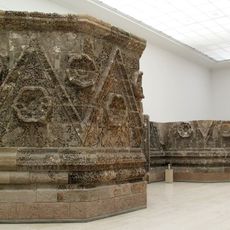
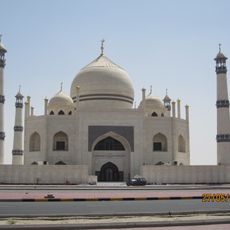
Qasr al-Muwaqqar, Umayyad desert castle in Al Muwaqqar, Jordan.
Qasr al-Muwaqqar is a ruined Umayyad desert castle about 30 km southeast of Amman, on a low hill in al-Muwaqqar. Its enclosure measured roughly 65 by 39 metres, with a surrounding wall, three watchtowers and eight barrel vaults about 4 metres wide. Eight decorated stone columns were found, several with acanthus ornament and one with Kufic inscriptions; remains of 18 cisterns and a large water reservoir lie nearby.
Qasr al-Muwaqqar was built under the Umayyad caliph Yazid II around 723. A surviving column names Abdallah ibn Sulaym as the architect. The building probably served as a central caravan station. In 1889 Alfred von Domaszewski and Rudolf Ernst Brünnow visited the site, and Alois Musil followed in 1901.
Eight decorated stone columns were found at the site, several carved with acanthus ornament and one bearing an inscription in Kufic script. Parts of these decorated stone pieces are now kept in the National Archaeological Museum in Amman. A surviving column names Abdallah ibn Sulaym as the architect.
The castle lies in al-Muwaqqar, about 30 km southeast of Amman and 15 km northeast of al-Qastal, on a low hill; the structure itself is largely destroyed, so look for the wall lines, the eight barrel-vaulted chambers and the remains of 18 cisterns. A large water reservoir lies southeast of the building. Parts of the decorated stonework are kept in the National Archaeological Museum in Amman.
Eight decorated stone columns were found at the site, several carved with acanthus ornament and one bearing an inscription in Kufic script. A surviving column names Abdallah ibn Sulaym as the architect. Carved pieces are now kept in the National Archaeological Museum in Amman.
The community of curious travelers
AroundUs brings together thousands of curated places, local tips, and hidden gems, enriched daily by 93,142 contributors worldwide.