Ōhori Kōen, Public park in Chūō-ku, Japan.
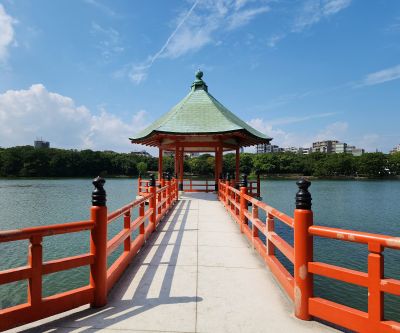
Ōhori Park is a public green space in Fukuoka centered on a large pond connected to three islands with walking paths stretching over two kilometers through landscaped grounds. The design includes artificial hills, curved walkways that wind around the water, and multiple garden sections arranged at different elevations throughout the site.
The site originated as a defensive moat surrounding Fukuoka Castle built in the early 1600s before being transformed into a public park in 1929. This conversion from fortress infrastructure to recreational space reflected changing urban priorities in early modern Japan.
The Japanese garden within the park displays traditional landscaping through carefully placed stones, seasonal plants, and artificial hills arranged to create balanced compositions. Locals use the walking paths regularly, especially during cherry blossom season when the park becomes a gathering place for viewing and picnicking.
The park lies about 2 km west of Tenjin in Chūō-ku. The subway Airport Line's Ōhori Kōen station is on the north side, and Ropponmatsu station on the Nanakuma Line is a 10-minute walk south. The pond circuit measures 1,921 m, and jogging and cycling paths were added in the 1990s.
The park's nickname as a copy of China's West Lake is not supported by the 1925 plan by Honda Seiroku and Nagami Kenichi, which mentions only that thousands of parks abroad were consulted. The idea spread after a Chinese-style pavilion was moved to the pond as Ukimidō for Emperor Shōwa's 1949 visit, and appeared in a 1968 city guidebook.
The community of curious travelers
AroundUs brings together thousands of curated places, local tips, and hidden gems, enriched daily by 94,048 contributors worldwide.