Usa Jingū, Shinto shrine in Usa, Ōita Prefecture, Japan.
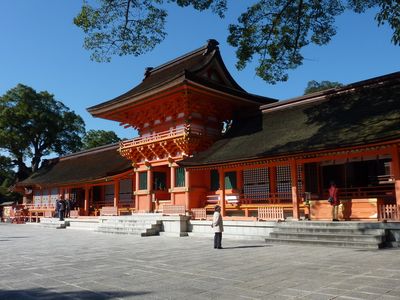
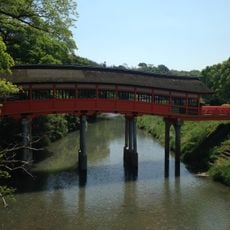
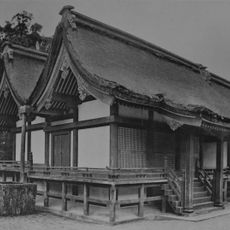
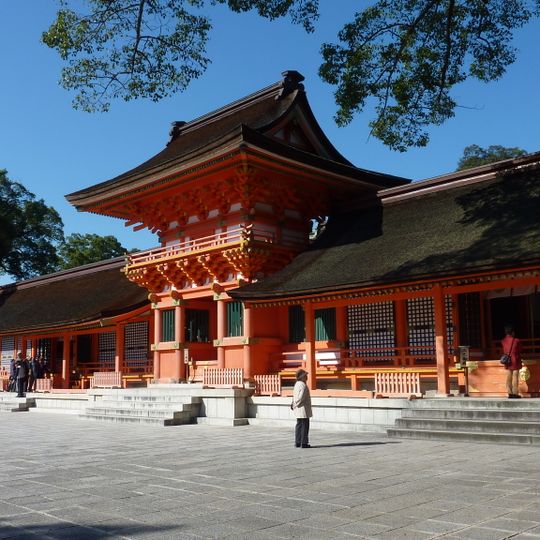
Usa Jingū is a Shinto shrine in Usa, Ōita Prefecture, whose main sanctuary stands on the hill of Ogurayama and whose lower shrine, Shimo-no-miya, sits at its foot. The three honden, built in the Hachiman-zukuri style, are National Treasures; each joins a front ge-in and a rear nai-in under two gabled roofs. The vermilion Kurehashi Bridge marks the west approach.
The complex was established in the 8th century and quickly grew into the main center for Hachiman worship across Japan. During the Nara and Heian eras, the site received support from the imperial court and became a major religious reference point throughout the country.
This place serves as the head for all Hachiman shrines throughout the country, shaping religious practice at thousands of related sites. Worshippers from across the nation travel here to take part in ceremonies held throughout the year and offer their prayers.
The precinct is entered from the west approach, where the vermilion Kurehashi Bridge, already standing in the Kamakura period, crosses to the shrine; it is an Important Tangible Cultural Property of Ōita Prefecture. The inner grounds hold the Kami-no-miya on the hill of Ogurayama and the Shimo-no-miya at its foot, with the Miroku-ji foundation stones still visible. Worship here is two bows, four claps and one bow.
Usa Jingū is regarded as the birthplace of the mikoshi; in 749 the shrine's portable shrine carried Hachiman's spirit from Kyushu to Nara to guard the casting of the Great Buddha of Tōdai-ji. By the 10th century, parading mikoshi during festivals had become common practice.
The community of curious travelers
AroundUs brings together thousands of curated places, local tips, and hidden gems, enriched daily by 92,812 contributors worldwide.