Okuni Shrine, Shinto shrine in Mori, Shizuoka Prefecture, Japan
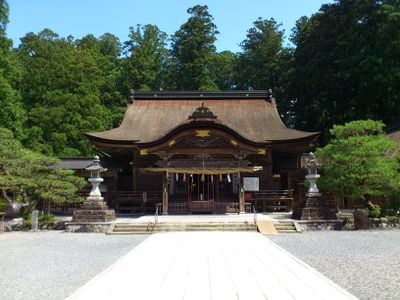
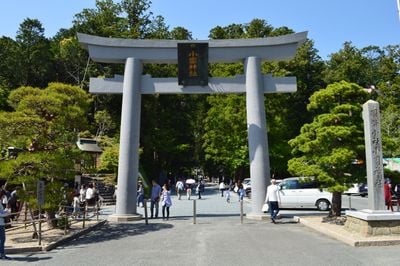
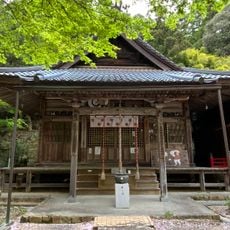
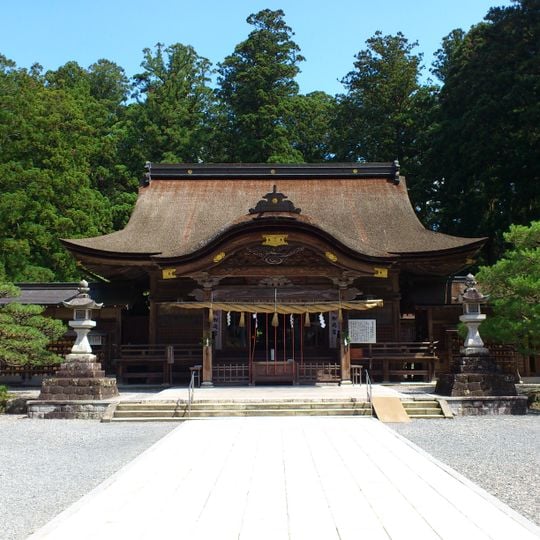
Okuni Shrine stands on the southern foot of Mount Hongu in Mori, Shizuoka Prefecture. Its main hall is built in taisha-zukuri style, 5.91 m wide and 13.03 m tall, with a cypress-bark roof; a semicircular sutra mound about 21 m across lies behind it. A stone torii with a gold-lettered plaque reading 小國神社 marks the approach, and a wooden hall with a thick thatched roof and hanging white streamers stands at the end of the stone path.
According to shrine tradition, the deity appeared on Mount Hongu in 555, during Emperor Kinmei's reign, and a shrine was built there by imperial order; the shrine was later moved to its present site. The first documentary mention is a 840 entry in the Shoku Nihon Kōki, which records a rank of Jugoige for "Okuni Tenjin of Shuchi District, Tōtōmi Province". It appears as a small shrine in the 927 Engishiki register, and the earliest record calling it Tōtōmi's ichinomiya dates from 1235. Tokugawa Ieyasu rebuilt the halls in 1575 after the shrine sided with him against Takeda Shingen.
The shrine's name is said to derive from a honorific contrast with Izumo's Kizuki Taisha, and it was also called Kotomachi Shrine for prayers awaited and Kotoai Shrine for wishes granted. Its rice-planting rite, the Taue-shinji, and the twelve-part bugaku dance are performed at the dance hall; the dance was designated an Important Intangible Folk Cultural Property in 1982 as part of the Mori dance traditions.
The shrine stands at the foot of Mount Hongu, about 50 minutes on foot from Tenryu-Hamanako Railway's Totomi-Ichinomiya Station, or roughly 10 minutes by a shuttle minibus that runs on Sundays and designated days. Drivers reach it in about 20 minutes from the Tomei Expressway's Fukuroi interchange or 15 minutes from the Shin-Tomei's Morikakegawa interchange, with free parking for around 800 cars. The approach runs from the stone torii along a broad stone path to the main hall.
Behind the main hall lies a semi-circular sutra mound about 21 metres across and 1.5 metres high, its south side open. When the hall was rebuilt after a fire in 1885, part of the mound was cut away, revealing three bronze sutra containers; a clay vessel holding them bears the date Nin'an 3, ninth month, eighteenth day (1168). Two mirrors and a curved sword were also found.
The community of curious travelers
AroundUs brings together thousands of curated places, local tips, and hidden gems, enriched daily by 93,310 contributors worldwide.