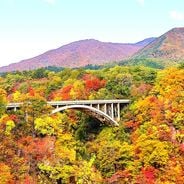
Lake Towada, Volcanic crater lake in Aomori Prefecture, Japan.
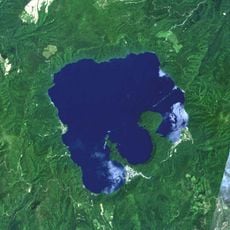
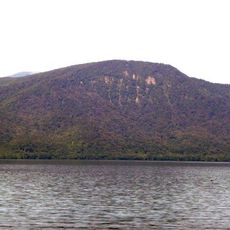
Lake Towada is a crater lake in Aomori Prefecture that sits in a volcanic basin surrounded by mountains and reaches a depth of 327 meters (1,073 feet). The shoreline is lined with dense forests, while the water shifts from deep blue to darker gray depending on the season.
Lake Towada fills a caldera of the Towada volcano, active from about 200,000 years ago; eruptions around 55,000, 36,000 and 15,000 years ago shaped an 11 km-wide basin, and water collected between roughly 15,000 and 12,000 years ago. Collapse of the Ogurayama and Mikadoishi lava domes about 5,400 years ago gave the lake its present outline. The last recorded eruption, in 915 AD in the Nakaumi caldera, buried much of Tōhoku in ash and caused crop failures and famine.
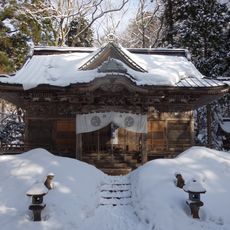
The name is thought to come from Ainu 'to watara', meaning 'rocky lake', not from any count of tributaries. On the Nakayama peninsula stands Towada Shrine, founded, by one tradition, in 807 by Sakanoue Tamuramaro and dedicated to Yamato Takeru; in the Edo period it was a Nambu domain sanctuary. The shrine honours Seiryu Gongen, the blue dragon said to have become the lake's master after driving out Hachirotaro.
Two ports serve the lake: Nenokuchi at the Oirase River outlet and Yasumiya on the southern shore, where excursion boats depart outside winter. Yasumiya holds the bus terminal, visitor centre and most lodgings; Utarube has camping and canoeing. The lake straddles the Aomori-Akita border, so shops sell both prefectures' specialities.
The water replaces itself fully roughly every eight to nine years as springs and inflows circulate slowly through the depth. Temperature remains cool beneath the surface even in midsummer, rising just above ten degrees Celsius (fifty degrees Fahrenheit).
The community of curious travelers
AroundUs brings together thousands of curated places, local tips, and hidden gems, enriched daily by 92,789 contributors worldwide.