Fushimi Castle, Japanese castle in Fushimi Ward, Kyoto, Japan
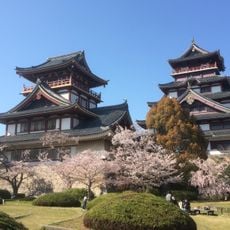
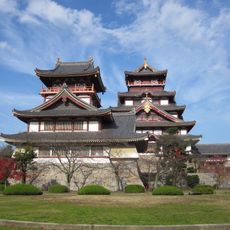
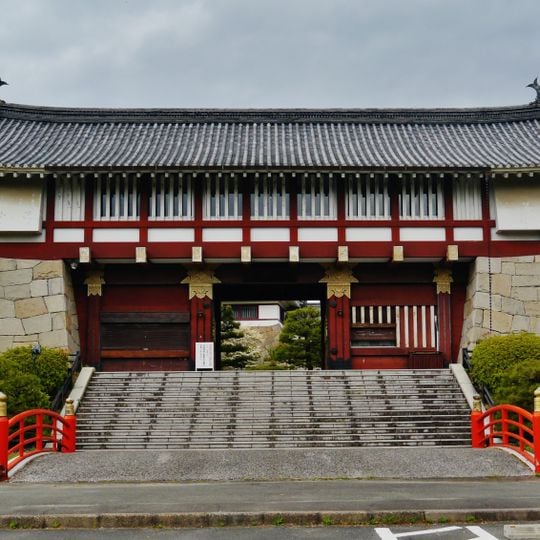
Fushimi Castle is a 1964 concrete replica of a five-storey, six-level keep with a three-storey, four-level small keep and a yagura-mon gate, built for the Fushimi Momoyama Castle Land amusement park. Its lower walls are rough light stone, above which white plastered walls are framed by dark timber, with red-painted railings and gables on the upper levels and dark grey tiled roofs with curved eaves. A gold-coloured ornament sits at the centre of the upper facade.
Toyotomi Hideyoshi began the first Fushimi Castle in 1592 at Shigetsu; it was completed in 1594 but collapsed in the 1596 Keichō-Fushimi earthquake. Rebuilt on nearby Mount Kobata by 1597, it was burned in 1600 during Ishida Mitsunari's siege, then reconstructed under Tokugawa Ieyasu around 1602 and dismantled in 1623, its buildings moved to Nijō, Yodo and Fukuyama castles.
The castle's name comes from the Momoyama hill where peach trees were planted after 1619, giving rise to the name Momoyama Castle. In 1964 a five-storey, six-level replica keep and a three-storey, four-level smaller keep were built in concrete for the Castle Land amusement park, and the replica was kept as a Fushimi symbol after the park closed in 2003.
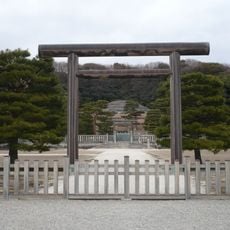
You can reach the site on foot in about 15 minutes from Momoyama Station on the JR Nara Line or in 20 minutes from Tambabashi Station. The main areas remain closed due to the Imperial tomb, but you can walk the hill paths during daylight hours.
The keep visitors see is a 1964 concrete replica, built for the Fushimi Momoyama Castle Castle Land amusement park at a cost of 600 million yen and modelled on the castle shown in the Rakuchu Rakugai screens. The park closed in 2003, but a citizens' campaign saved the keep, which was given to Kyoto City and now stands in Fushimi Momoyama Castle Sports Park.
The community of curious travelers
AroundUs brings together thousands of curated places, local tips, and hidden gems, enriched daily by 92,301 contributors worldwide.