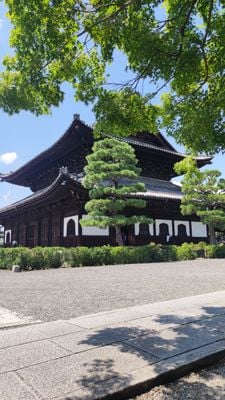
Kennin-ji, Zen temple in Higashiyama, Kyoto, Japan.
Kennin-ji is a Zen temple in the Higashiyama district of Kyoto, Japan, offering stone pathways and gravel gardens between its wooden halls. The compound features a meditation garden with three large rocks surrounded by white gravel, and interior courtyards that connect through covered corridors for visitors to explore.
Eisai founded Kennin-ji in 1202 with support from shogun Minamoto no Yoriie, modelling its layout on Chinese monasteries. After fires in 1246, 1247 and 1256, Enni restored the Buddha Hall, and the Song monk Lanxi Daolong made it a pure Zen monastery as eleventh abbot. The hōjō was moved here from Ankoku-ji in Aki Province in 1599 by Ankokuji Ekei.
The temple is named after the Kennin era (1202–1204) in which it was founded. Its guardian shrine, Kyoto Ebisu Shrine, was built on the west side of the grounds in the same year. Tawaraya Sōtatsu's pair of folding screens depicting the Wind God and Thunder God is now kept at the Kyoto National Museum, not in the main hall.
The main gate, Chokushimon, faces Yasaka-dori on the south side; the Hōjō and gardens lie north of it. The Hōjō is linked to the Hattō by a covered corridor. The Chokushimon is a four-legged gate with arrow marks on its pillars and doors.
The ceiling painting shows two dragons covering an area as large as 108 tatami mats placed together. Visitors often notice that the dragons appear to follow their gaze from every angle in the room.
The community of curious travelers
AroundUs brings together thousands of curated places, local tips, and hidden gems, enriched daily by 92,781 contributors worldwide.