Nison-in Temple, Buddhist temple in Sagano district, Japan
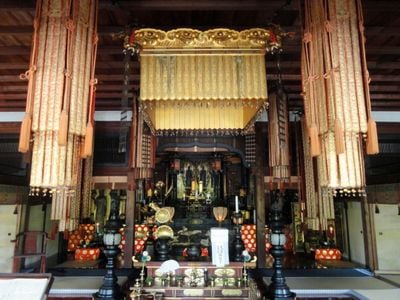
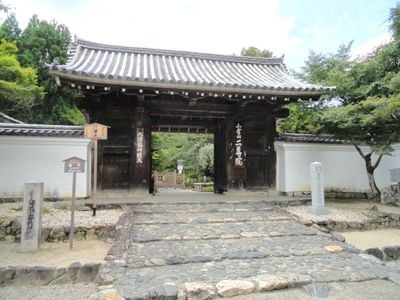
Nison-in is a Tendai temple on Mount Ogura in Sagano, entered through a gate moved from Fushimi Castle in 1613 by the merchant Suminokura Ryōi. Its main hall, rebuilt in 1521 with funds raised by Sanjōnishi Sanetaka, holds the two statues that give the temple its name. Behind it lie the garden of the Six Jizō of the Six Realms and the hall's imperial plaque in the hand of Emperor Go-Nara.
Nison-in was founded in the early Heian period: Emperor Saga initiated its establishment in 834, and Ennin (Jikaku Daishi) founded it by imperial vow. In the early Kamakura period Tanzan, a leading disciple of Honen, revived it as a four-school centre; in 1227 Honen's remains were escorted here for protection. The Onin War (1467–1477) burned the halls, and in 1521 the 16th abbot Ekyo had the main hall and karamon rebuilt with funds raised by Sanjonishi Sanetaka.
The two wooden figures stand at the center of worship and draw believers who pray to both forms of Buddha. This dual focus gives the temple its name and makes it a special place for Buddhist practice.
The temple opens in the morning and closes in the afternoon, with an entrance fee required. From Saga-Arashiyama Station, a short walk through the residential area leads to the grounds.
The main gate was moved here from Fushimi Castle in 1613, donated by the merchant Suminokura Ryōi, and its tiles were relaid in 2014. The temple's bell, cast in 1992, is called the "Bell of Happiness". The grave of actor Bandō Tsumasaburō also stands in the cemetery.
The community of curious travelers
AroundUs brings together thousands of curated places, local tips, and hidden gems, enriched daily by 93,334 contributors worldwide.