Fukuyama Castle, Japanese castle in Fukuyama, Japan.
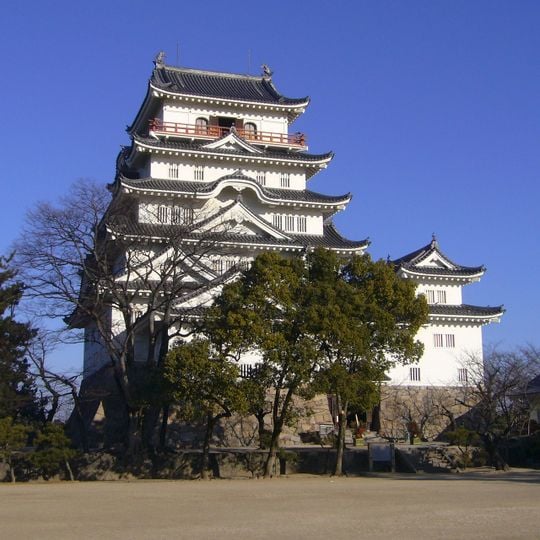
Fukuyama Castle stands on a hill 400 meters long and 200 meters wide, with a five-story keep at its northern edge. The keep has white plastered walls, dark grey tiled roofs, and stacked tiers with curved eaves. Red-railed balconies run along the upper floors, and a lower white wing connects to the main tower. The present keep, rebuilt in reinforced concrete in 1966, houses the Fukuyama City Fukuyama Castle Museum.
Mizuno Katsunari received a 100,000-koku domain in Bingo Province in 1619 and obtained an exception to the one-domain-one-castle rule to build on reclaimed tidal flat. Construction ran from 1619 to 1622, using stone from the abolished Kannabe Castle and materials granted from Fushimi Castle. The Abe clan took over in 1698 and held the castle until the Meiji Restoration; in January 1868 Chōshū troops attacked but the domain switched sides and the castle was spared.
The castle grounds include Fukuyama Park, where the cherry trees planted in 1915 on the secondary bailey's south side made it a noted blossom-viewing spot. The Fushimi Yagura and Sugitetsu Gomon gate, both Important Cultural Properties, are the only original structures to survive the 1945 air raid. The reconstructed keep houses the Fukuyama City Fukuyama Castle Museum.
The grounds lie within walking distance from Fukuyama Station and open daily from 9 AM to 5 PM. Access to the site and the main outdoor areas is straightforward, though some paths involve gentle slopes.
The keep's north side is clad in black iron plates, while the other three sides are white plaster. The iron plating was a defensive measure, and it makes the reconstructed keep look different from each of its four sides. The keep also has two attached yagura, a compound layout.
The community of curious travelers
AroundUs brings together thousands of curated places, local tips, and hidden gems, enriched daily by 94,049 contributors worldwide.