Fukuju Kaikan, Historic house near Fukuyama Castle, Japan.
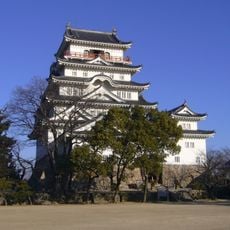
Fukuju Kaikan is a villa complex in Fukuyama Castle Park, built on the site of a former castle rice storehouse. It consists of a single-storey Japanese-style main building with a 21-tatami hall, a wooden two-storey Western wing of 138 square metres with a steep gabled tile roof and Italian Renaissance-style decorations on its pillars and windows, and a pond-strolling garden, all on a site of about 7,400 square metres.
The villa was built in the 1930s by Wasuke Anbe, a seafood merchant credited with inventing dried bonito flakes and known as the "bonito king." It survived the 1945 Fukuyama air raid that destroyed the neighbouring castle keep. Fukuyama Tsūun founder Noboru Shibuya bought it and donated it to the city in 1953; from 1973 the Western wing served as the city guesthouse.
The main building's large hall, guest rooms, and two tea rooms are rented out, and the tea rooms keep their tea-ceremony function today. The name Fukuju Kaikan comes from the villa of Wasuke Anbe, the dried-bonito maker called the "bonito king". The Western wing, registered in 1997, is used for city history compilation rather than ceremonies.
The main building's rooms and tea rooms are rented out, while the Western wing has housed the city history compilation office since 1992 and opened to the public on 1 April 2009. It is a 3- to 5-minute walk from JR Fukuyama Station, and the grounds sit on the lower north side of the former outer bailey of Fukuyama Castle.
The villa was built in the 1930s by Wasuke Anbe, a seafood merchant credited with devising katsuobushi and known as the "Bonito King". To create its private approach, part of the stone wall of Fukuyama Castle's outer bailey was dismantled for a new road, cutting the grounds off from the bailey's east side.
The community of curious travelers
AroundUs brings together thousands of curated places, local tips, and hidden gems, enriched daily by 93,801 contributors worldwide.