Jingo-ji Temple, Buddhist temple in Takao, Kyoto, Japan
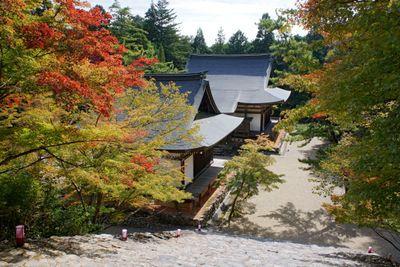
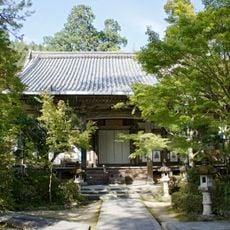
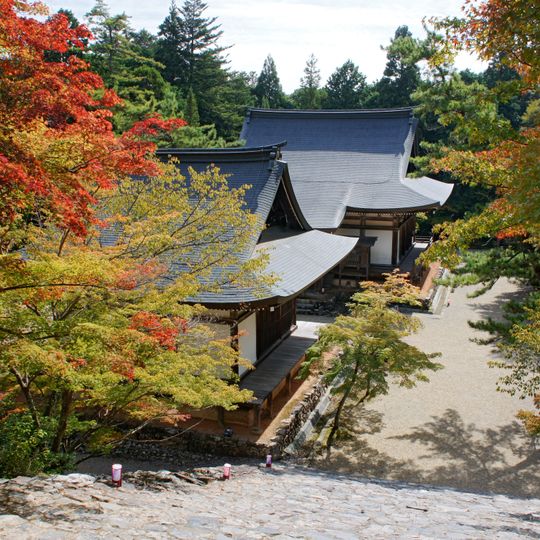
Jingo-ji is a Shingon Buddhist temple on the slope of Mount Takao in Ukyō Ward, Kyoto. Its Kondō is a large timber hall on a stone base, with broad stone steps up to a railed veranda, pale lattice panels in the outer bays, and a deep grey-tiled roof supported by red-brown beams and brackets. A lower wing with a second tiled roof stands to one side, and a covered walkway with a dark floor runs along a low stone retaining wall.
Jingo-ji was formed in 824 by the merger of two private temples of the Wake clan: Jingan-ji, founded by Wake no Kiyomaro around 781, and Takaosan-ji, which already stood on the present site. Kukai stayed at Takaosan-ji in 812 and performed an abhisheka there. After fires in 994 and 1149, the monk Mongaku began restoring the temple in 1168, and the work was completed in 1226.
Visitors come to throw kawarake, small clay discs that sail over the forested slopes from a platform, symbolically carrying worries away. The temple displays bright red maple trees in autumn that stand out against the dark wooden buildings and draw many photographers.
The climb from the Takao bus stop takes about twenty minutes up a steep stone staircase through the forest. The complex opens in the morning and closes in the late afternoon, with the path becoming slippery during rain.
The main hall preserves a wooden statue of Yakushi Nyorai from the Heian period, counted among Japan's National Treasures. Monks still hold prayers in the early morning hours when mist hangs between the trees and bells ring through the valley.
The community of curious travelers
AroundUs brings together thousands of curated places, local tips, and hidden gems, enriched daily by 93,268 contributors worldwide.