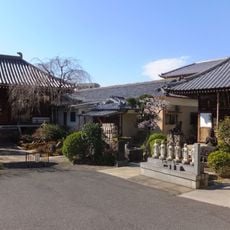
Kisshō-ji, Buddhist temple in Hon-Komagome, Japan
Kisshō-ji is a Soto Zen temple at 3-19-17 Hon-Komagome, Bunkyo ward, Tokyo. Its single-storey main hall has a wide green copper roof curving up at the corners, a dark wooden facade with three bays between round red pillars, lattice windows in the side bays and a recessed central doorway. Two stone lions flank the steps to a low stone platform, and a small dark plaque hangs above the pillars. The 1802 mountain gate and 1804 sutra repository survive from the Edo-period seven-hall compound.
Ota Dokan established the site in 1458 after finding a golden seal inscribed with characters meaning good fortune while digging a well for Edo Castle construction. Centuries later, after a devastating fire swept through the area in 1657, many followers moved westward and founded a new settlement they named after this temple.
The temple's name comes from a gold seal inscribed "Kichijō" (good fortune), found in a well near Wadakura during the building of Edo Castle. In the Edo period its precinct held the Sendan-Rin study hall, where over 1,000 monk-students lived; it became Komazawa University in 1925. The graves include that of Enomoto Takeaki, buried here in 1908, and a joint tomb of Yaoya Oshichi and Kichisaburō.
The temple stands at 3-19-17 Hon-Magome, Bunkyo ward, a short walk from Honkomagome Station on the Namboku subway line. The present main hall, guest hall and kitchen buildings are postwar reconstructions; the 1802 mountain gate and 1804 sutra repository survive from the Edo-period compound.
A neighborhood far to the west of here carries the name Kichijoji, borrowed from this temple by settlers who moved there after losing their homes in a 17th-century fire. Though they named their new district after the temple, they never built another one with the same name there.
The community of curious travelers
AroundUs brings together thousands of curated places, local tips, and hidden gems, enriched daily by 93,323 contributors worldwide.