Sinharaja Forest Reserve, Protected rainforest in Southern Province, Sri Lanka
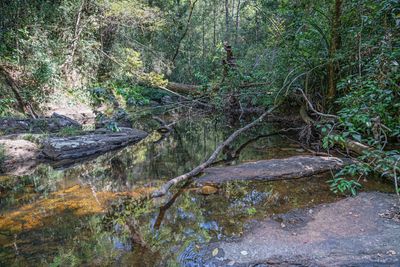
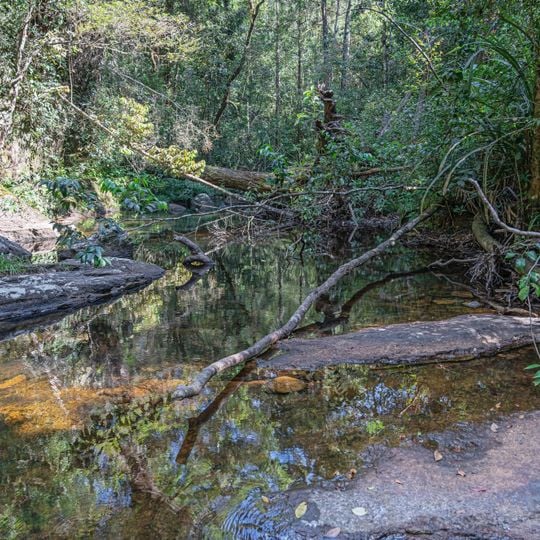
Sinharaja Forest Reserve is a protected rainforest in Sri Lanka's south-west wet zone, covering 36,000 hectares of primary tropical forest. Its terrain of hills, slopes and valleys ranges from 300 to 1,170 metres above sea level. The forest is a watershed for the Kalu Ganga and Gin Ganga, with streams flowing between dark rock slabs and fallen trunks.
Part of the forest was declared a forest reserve on 3 May 1875. In 1971 about 2,500 hectares were placed under strict protection with the IUCN and the International Biological Programme, and logging throughout the forest was banned in 1977. UNESCO named it a biosphere reserve in April 1978 and a World Heritage Site in 1988, the same year it became a national heritage wilderness area on 21 October.
Villages along the reserve border collect herbal medicine, edible fruits, nuts, mushrooms, bees' honey and a sugary sap from a local Caryota palm. The name Sinharaja is popularly linked to a legendary lion said to have lived in the forest. Visitors enter with a licensed guide from Weddagala, Rakwana, Neluwa or Deniyaya-Mederipitiya.
All visitors must enter the forest with a licensed guide. There are four main entrances: Weddagala in the north-west, Rakwana in the north-east, Neluwa in the south-west, and Deniyaya–Mederipitiya in the south-east. The terrain is hilly, with elevations from 300 to 1,170 metres, and the annual rainfall of 3,614 to 5,006 mm makes waterproof gear and leech protection useful.
The reserve holds 19 of Sri Lanka's 20 endemic birds, including the red-faced malkoha, green-billed coucal and Sri Lanka blue magpie. Martin Wijesinhe served as its unofficial guardian and caretaker from the 1950s until his death in 2021.
The community of curious travelers
AroundUs brings together thousands of curated places, local tips, and hidden gems, enriched daily by 93,331 contributors worldwide.