Pyramide van Austerlitz, Military monument pyramid in Woudenberg, Netherlands.
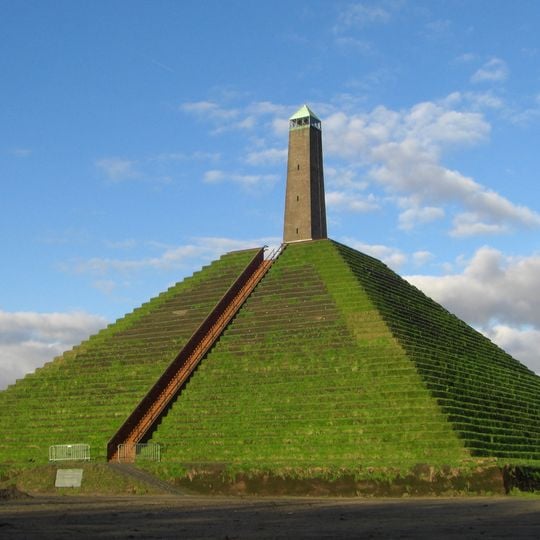
The Pyramide van Austerlitz is a grass-covered, pyramid-shaped sand hill measuring 40 by 40 metres, topped by a stone obelisk. Its total height is 33 metres, including the 16-metre obelisk added in 1894. A staircase of 81 steps leads up the front face to a platform at the obelisk, which now leans slightly.
General Auguste de Marmont ordered French soldiers to build the pyramid during the summer of 1804 as a way to keep troops occupied during a period of rest. The work lasted 27 days and aimed to maintain military discipline.
The hill was first named Mont Marmont after General Marmont, but in 1806 King Louis Bonaparte renamed it after Austerlitz, the battle Napoleon won in December 1805, and gave the same name to the nearby trading post of Bois-en-Ville. The obelisk on top leans slightly; since 2010 this tilt has been treated as a mark of the monument's eventful past.
The climb to the obelisk platform uses a staircase of 81 steps, and the pyramid can be climbed again since its reopening in 2008. A visitor centre opened the same year covers the French period in the Netherlands. The stone obelisk has leaned since it was fixed on piles in 2010 and was deliberately not straightened.
The design follows Egyptian models but uses only local materials such as earth and grass turf. This approach made the project an experiment in military earthwork architecture during the Napoleonic era.
The community of curious travelers
AroundUs brings together thousands of curated places, local tips, and hidden gems, enriched daily by 93,808 contributors worldwide.