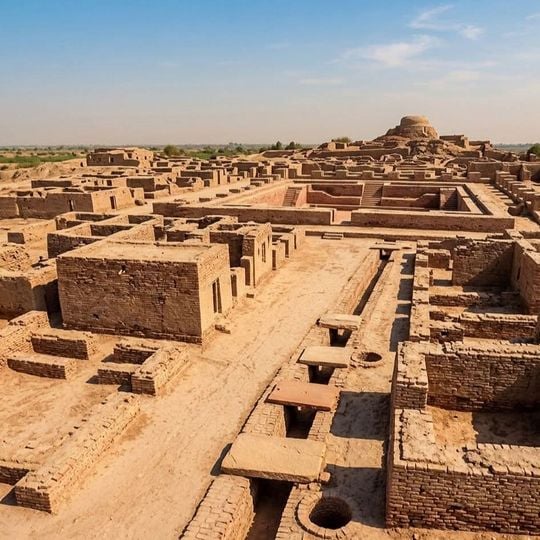
Mohenjo-daro, Archaeological site from Indus Valley Civilization in Larkana District, Pakistan.
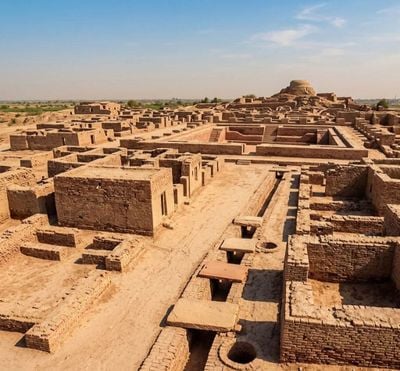
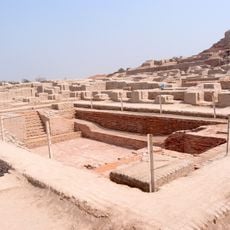
Mohenjo-daro is an archaeological site from the Indus culture in Larkana District, showing foundations of residential buildings, streets, and drainage channels. The structures consist of fired bricks made to uniform standards, and many areas show multiple construction layers stacked on top of each other.
The settlement began around 2500 BCE and remained occupied until approximately 1700 BCE, before residents likely left the area due to recurring floods and climate shifts. British and American archaeologists started systematic excavations in the twentieth century, work that continued across several decades.
The modern name is Sindhi for "Mound of the Dead Men"; the city's original name is unknown. Iravatham Mahadevan, analysing a seal from the site, proposed the ancient name Kukkuṭārma, "city of the cockerel", and linked it to cock-fighting that may have had ritual importance. The site has been a UNESCO World Heritage Site since 1980, the first in South Asia.
The excavated area covers roughly a third of the estimated 300-hectare city, with the Citadel mound rising about 12 metres above the Lower City. Excavations were halted after 1965 because exposed brickwork was weathering, so visitors walk among conserved structures rather than active digs. The site lies about 28 kilometres from Larkana, off the west bank of the Indus.
Some houses had waste chutes connected directly to underground channels, a sanitation system that was remarkably advanced for the Bronze Age. Archaeologists also found skeletons in unusual positions, possibly indicating sudden death during a late occupation phase, though the exact context remains a subject of debate.
The community of curious travelers
AroundUs brings together thousands of curated places, local tips, and hidden gems, enriched daily by 92,322 contributors worldwide.