Holy Cross Monastery, Benedictine monastery at Łysa Góra, Poland
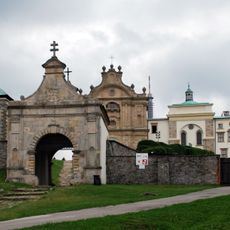
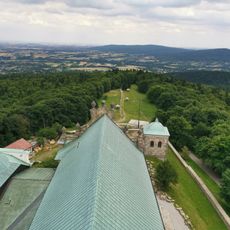
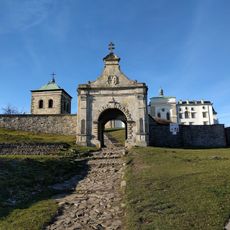
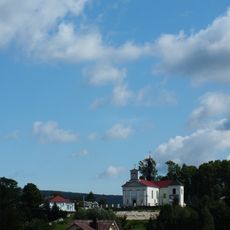
The Holy Cross Monastery crowns Łysa Góra in the Świętokrzyskie Mountains. Its basilica, rebuilt in late Baroque style in 1781–1789 to Józef Karsznicki's design, has a tiered stone facade with a round window, a circular medallion and a white doorway painted with blue geometric symbols. A lower white-plastered wing with a copper-clad cupola extends to the right, and the rebuilt tower rises 45 m.
The exact founding date is unknown: Benedictine tradition dates the monastery to 1006 under Bolesław I the Brave, while other accounts place it in the first half of the 12th century under Bolesław III Wrymouth. The first Romanesque church was founded between 1102 and 1138 by Bolesław Krzywousty. In 1306 Duke Władysław Łokietek gave the monks relics of the Holy Cross, which tradition says came from Saint Emeric of Hungary.
The sanctuary's name comes from the relics of the Holy Cross, kept since 1723 in the Oleśnicki Chapel, where a sarcophagus holds Jeremi Wiśniowiecki. Two feasts are celebrated solemnly: the Exaltation of the Holy Cross on 14 September and the Most Precious Blood of Jesus on the first Sunday of July. The monastery also houses a museum of the Świętokrzyski National Park.
An asphalt road from Huta Szklana or Nowa Słupia leads up to the monastery, allowing access by car or on foot. Electric trolleys operate along this route during summer months, offering an easier way to reach the summit.
The Oleśnicki Chapel, built 1614–1620 at Mikołaj Oleśnicki's expense, has held the Holy Cross relics since 1723; they are kept in a tabernacle there. In its crypt lies the sarcophagus of Jeremi Wiśniowiecki, voivode of Ruthenia. The monastery also houses a museum of the Świętokrzyski National Park.
The community of curious travelers
AroundUs brings together thousands of curated places, local tips, and hidden gems, enriched daily by 94,676 contributors worldwide.