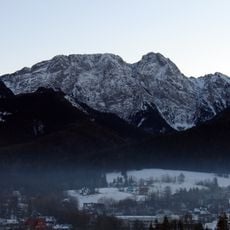
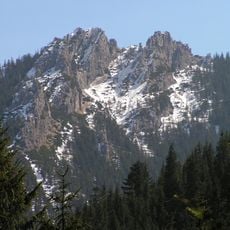
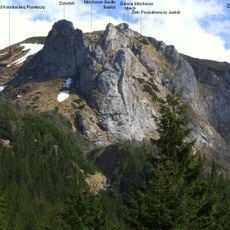
Giewont Cross, Monumental cross on Giewont Mountain, Poland.
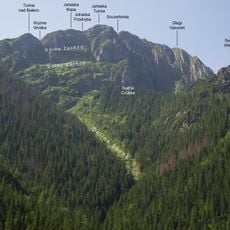
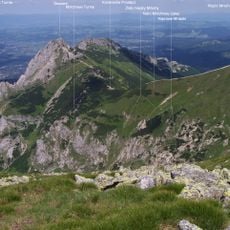
Giewont Cross is a 17.5-metre metal cross on the summit of Wielki Giewont (1894 m) in the Tatra range above Zakopane. Its open lattice shaft rises from a small base set in the rock, crossed by a 5.5-metre horizontal arm with a short finial above; 2.5 m of the structure is sunk into the rock. It is built from 400 iron elements weighing 1819 kg, and the Latin inscription Jesu Christo Deo, restitutæ per ipsum salutis MCM marks the arm intersection.
Zakopane parish priest Kazimierz Kaszelewski initiated construction in August 1901 to commemorate the 1900th anniversary of the birth of Christ. Volunteers carried the iron parts up the steep mountainside to complete the assembly.
At the crossing of the arms is the Latin inscription "Jesu Christo Deo, restitutæ per ipsum salutis MCM", marking the 1900th anniversary of the birth of Christ. Pilgrimages from the Church of the Holy Cross in Zakopane reach the cross on 19 August, the anniversary of its consecration, and on 14 September, the Feast of the Exaltation of the Holy Cross.
The summit lies about two to three hours on foot from trailheads in Zakopane and requires sure footing on rocky terrain. During thunderstorms, visitors should stay away from the cross because it acts as a lightning rod.
The cross is visible from Zakopane and can be watched through a telescope from the top of Gubałówka. Replicas stand in Pustkowo on the Baltic coast, on the Lednica fields and in Wojcieszów in Lower Silesia. Since 6 September 2007 the cross has been listed in the register of monuments of the Lesser Poland Voivodeship.
The community of curious travelers
AroundUs brings together thousands of curated places, local tips, and hidden gems, enriched daily by 94,226 contributors worldwide.