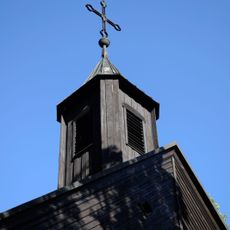
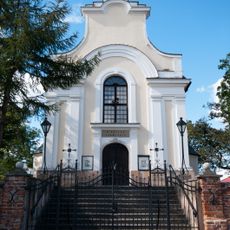
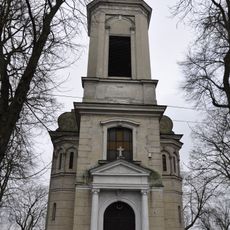
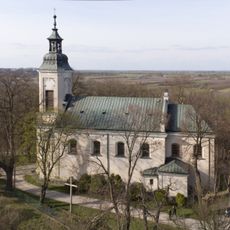
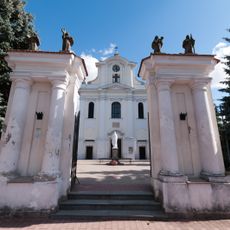
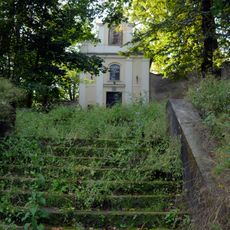
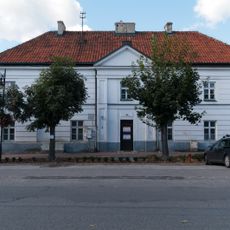
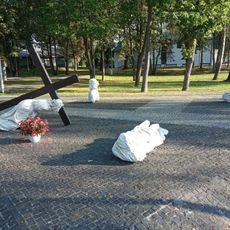
Immaculate Conception church in Góra Kalwaria, Baroque brick church in Góra Kalwaria, Poland.
The Immaculate Conception church is a Baroque masonry building designed by Jakub Fontana, erected in 1756 on the site of a wooden church destroyed by a hurricane or fire. Its fronton carries a plaque inscribed "Vota mea", set in 1848 to mark the building's restoration. Inside, four side altars hold paintings by Szymon Czechowicz, and an 18th-century baptismal font stands in the church.
Franciszek Bieliński founded the church in 1756 for the Bernardine order, replacing a wooden building destroyed by a hurricane or fire. The Polish architect of Italian origin Jakub Fontana designed it. In 1864 the Tsarist authorities dissolved the Bernardine monastery for the monks' part in the January Uprising, and in 1897 the church became the parish church of the Immaculate Conception.
The church has been run by Marian priests since 8 April 1952, when the parish was handed over to them. Inside, four side altars hold paintings by Szymon Czechowicz showing the Presentation of Christ in the Temple, the Holy Family, St Francis of Assisi and St Anthony of Padua. A black marble sarcophagus keeps the relics of St Valerian, brought to Góra Kalwaria in 1683 by Bishop Stefan Wierzbowski.
The church is located about an hour from Warsaw and opens daily for visitors interested in exploring its Baroque architectural features. Visitors should be mindful of service times and respect the sacred nature of the space during their visit.
The black marble sarcophagus holds relics of St. Valerian, brought to Góra Kalwaria in 1683 by Bishop Stefan Wierzbowski. Behind the main altar is a chapter house, and the sacristy keeps 18th-century inlaid furniture. The church appears in Wojciech Smarzowski's 2012 film Traffic Department.
The community of curious travelers
AroundUs brings together thousands of curated places, local tips, and hidden gems, enriched daily by 93,067 contributors worldwide.