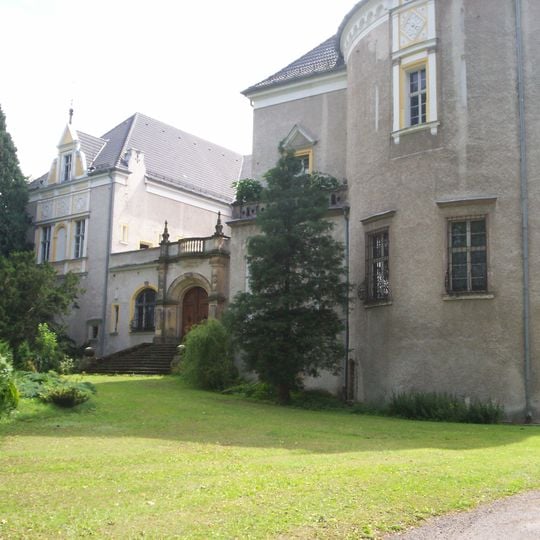
Palace in Czernica, Lower Silesian Voivodeship, Renaissance palace in Czernica, Lower Silesian Voivodeship, Poland
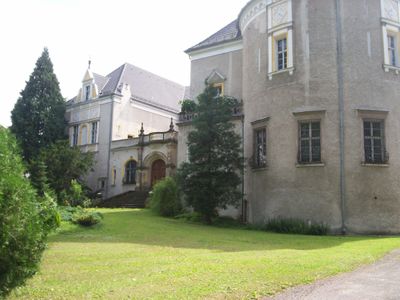
The Palace in Czernica is a two-storey brick building arranged in a horseshoe plan around a closed courtyard, the fourth wing having been added after 1861. It was rebuilt in Neo-Renaissance style, recalling French Loire châteaux, and in 1911 a massive semicircular tower with a conical roof was added at the north-west corner.
The palace probably originated as a fortified house built in the 14th century by the knights von Langenow. In 1543 Caspar I von Schaffgotsch's son had it rebuilt as a three-winged Renaissance residence. In May 1574 the theologians Flacius Illyricus and Jacob Colerus held a disputation here. After 1787 the von Förster family remodelled it in Neo-Renaissance style, and in 1861 Leopold Schoeller acquired it for his daughter Adele, adding a fourth wing to close the courtyard.
The village of Czernica is the German Langenau, and the palace was the seat of the knights von Langenow, from whom the name derives. In May 1574 the theologian Flacius Illyricus and Jacob Colerus held a disputation at the castle. Today the building is privately owned.
The palace stands in Czernica in Jelenia Góra County, Lower Silesia. It has been privately owned since 1992, so the interior is not open as a regular museum; visits depend on the owner's consent. The building is entered from the courtyard side, which was closed off when the fourth wing was added.
At the end of World War II the palace was requisitioned by the Reichsleiter Alfred Rosenberg's music task force as a depot for looted art, holding valuable musical instruments and original 18th-century scores. These fell to the Red Army with the German capitulation on 8 May 1945; much of the collection was destroyed or carried off, while the palace itself survived intact.
The community of curious travelers
AroundUs brings together thousands of curated places, local tips, and hidden gems, enriched daily by 94,162 contributors worldwide.