Sybillenort Castle, Gothic Revival palace in Szczodre, Poland.
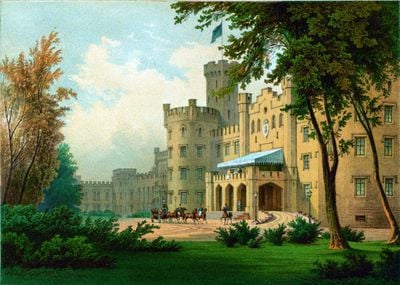
Sybillenort Castle is a ruined Gothic Revival palace in Szczodre, its surviving north part of the east wing built of pale yellow masonry with two octagonal corner towers and a crenellated parapet. The 1851–1867 rebuilding by architect Carl Wolf gave it a 300-metre facade with Tudor arches and battlements. Only fragments remain, including a former theatre wing now used as housing.
Christian Ulrich I of Württemberg-Oels bought the villages in 1685 and built a summer residence by 1692, naming it after his wife Sibylle Maria. After 1715 it stood unfit for habitation until Duchess Sibylle Charlotte had it renovated in 1716. Duke Friedrich August extended it from 1792 to 1805, adding wings, domed towers and a theatre. From 1851 to 1867 Carl Wolf rebuilt it in English Tudor style for Duke Wilhelm, creating the "Silesian Windsor". In January 1945 the Wehrmacht blew up the central block and the building burned out; demolition of the ruins continued until 1989.
The palace name honours Sibylle Maria of Saxe-Merseburg, second wife of Duke Christian Ulrich I, who bought the estate in 1685. Under the Saxon kings the theatre became a chapel with a marble altar brought from Venice, and the dining room walls were covered with embossed leather showing antique scenes. A memorial cross for King Albert I, erected by his wife Carola, stands in the former park.
The site lies about 13 kilometers northeast of Wrocław and holds protected monument status in Poland. Visitors should check access conditions in advance, as the structure remains under heritage protection with limited visitation options.
The 1999 theft of the cast-iron lions from the park gate removed a feature that had stood at the entrance since the 19th-century rebuilding. The gate itself, with its iron grille, survives and is listed together with the wing, outbuilding and park.
The community of curious travelers
AroundUs brings together thousands of curated places, local tips, and hidden gems, enriched daily by 94,583 contributors worldwide.