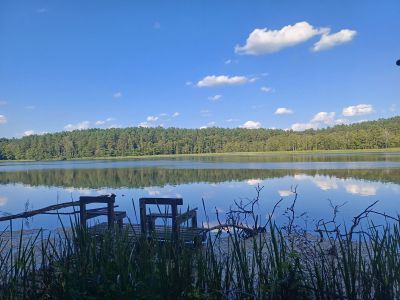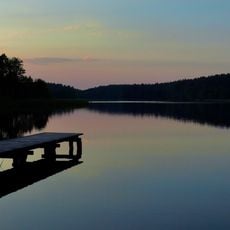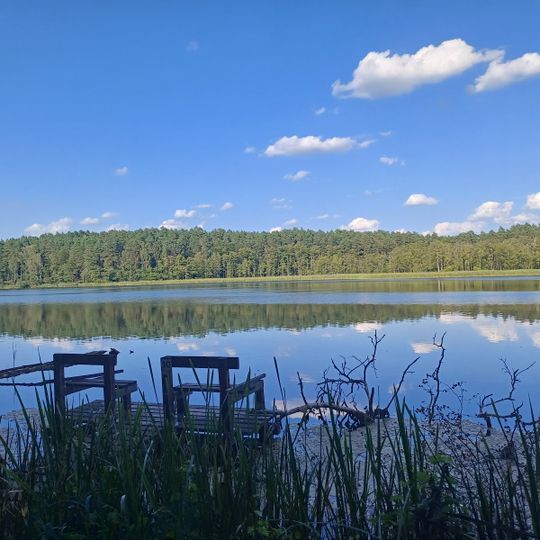
Jezioro Ostrowite, Lake in Drawa National Park, Poland
Ostrowite, known in German as Bahrenort-See, is the largest lake in Drawa National Park, lying on the Drawa Plain with its eastern shore forming the border between Lubusz and West Pomeranian voivodeships. The 387.6-hectare basin divides into several distinct pools, the northern one crossed by the Płociczna river. Its shoreline is highly varied, with named peninsulas such as Dębowy, Korea and Harcerski, and three islands: Chycza, Chroniec and Okółko.
The lake was formed during the Pleistocene period when glaciers carved out this depression and left numerous water bodies across northern Poland. This geological origin shapes the landscape character of the region to this day.
The name Ostrowite appears in records as early as 1532 as Ostrobythe; in 1937 German sources called it Bahrenort See, and the official Polish name Jezioro Ostrowite was set on 29 November 1955. The state register also lists the variants Jezioro Ostrowieckie, Jezioro Ostrowite and Ostrowiec. The lake's islands carry their own names: Chycza (also called Wyspa Okrzei), the hilly Chroniec (Lech) and the smallest, Okółko (Pokrzywka).
The lake lies entirely within Drawa National Park, and a tourist trail runs along its western shore. Overnight stays and campsites at the water are prohibited, and fishing is restricted because the waters are treated as special. The nearest settlement is the hamlet of Ostrowite on the south-eastern shore.
The lake's three islands total 5.8 hectares: Chycza, also called Wyspa Okrzei, the hilly Chroniec or Lech, and the smallest, Okółko or Pokrzywka. The named peninsulas include Dębowy and Korea on the western shore and Harcerski on the eastern shore.
The community of curious travelers
AroundUs brings together thousands of curated places, local tips, and hidden gems, enriched daily by 93,328 contributors worldwide.