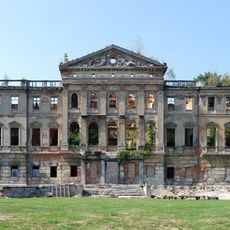
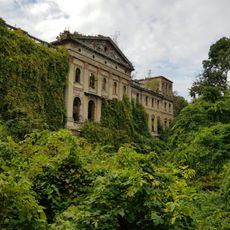
Fryderyk von Opersdorff Palace, Renaissance palace in Polska Cerekiew, Poland
Fryderyk von Opersdorff Palace is a brick palace built in 1617 in the late Renaissance style, forming a three-winged U-shaped plan around a small courtyard. Two octagonal towers with helms flank the main facade, where fragments of sgraffito decoration from around 1617 survive. Remnants of the Gothic castle remain in the lower parts of the south-eastern section, and traces of the moat are still visible.
The palace was built in 1617 by Fryderyk von Opersdorff and has shaped the village since then. A major renovation in 1894 and fire damage in 1945 significantly altered its appearance.
The entrance portal displays heraldic coats of arms from the noble families who owned the property over time, including the Opersdorff and Gaschin lineages. These carved emblems show who held power here across different periods.
The palace is not freely open to visitors and stands within a castle park in Polska Cerekiew. The grounds form a complex with a gatehouse building and traces of the former moat. The ground floor now serves social and cultural purposes, housing the municipal library and the Euro-Country association, and one room is used for civil wedding ceremonies.
The neo-Renaissance portal added in 1894 carries a cartouche with the Matuschka coat of arms and two Latin inscriptions: one records that Friedrich, free baron von Oppersdorff, raised the house in 1617, the other commemorates Count Eberhard Matuschka-Toppolczan in 1894. A medallion with the Oppersdorff arms sits above the semicircular entrance.
The community of curious travelers
AroundUs brings together thousands of curated places, local tips, and hidden gems, enriched daily by 93,466 contributors worldwide.