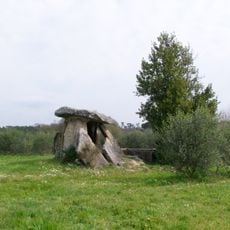
Dolmen of Cunha Baixa, Neolithic burial site in Cunha Baixa, Portugal
The Dolmen of Cunha Baixa is a Neolithic burial monument built from granite stones in the Portuguese Beira Interior region. Nine upright stone slabs form a roofed chamber connected to an entrance passage that faces downhill toward the surrounding landscape.
Built between 3000 and 2500 BC, the dolmen is attributed to the Beaker culture and represents a late phase of megalithism in the region, with use continuing into the Bronze Age. Leite de Vasconcelos documented it in 1892, finding the chamber filled with earth and brambles; his excavation yielded polished stone adzes, flint blades, microliths, pottery and ochre. It was declared a National Monument on 16 June 1910, and Raquel Vilaça and Domingos Cruz directed restoration work in 1987.
The anta was a collective burial place used from about 3000–2500 BC into the Bronze Age, when the last objects were deposited. Excavations by Leite de Vasconcelos in 1892 uncovered polished stone axes, flint blades and microliths, red and black pottery, yellow ochre for body painting and a human bone. The finds are now in Lisbon's National Archaeological Museum.
Visitors reach the monument by walking from the nearby road through footpaths that pass vineyards and forested areas. The approach is manageable on foot, though sturdy shoes and attention to ground conditions help ensure a comfortable visit.
A massive roof slab with rounded edges covers the burial chamber below, shaped with precision from a single block of granite. This engineering feat reveals the sophisticated building knowledge that Neolithic communities possessed to create such durable structures.
The community of curious travelers
AroundUs brings together thousands of curated places, local tips, and hidden gems, enriched daily by 93,775 contributors worldwide.