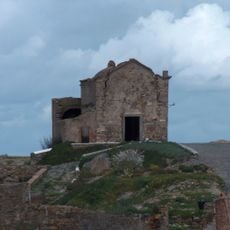
Castle of Lousa, Submerged Roman fortified farmstead in Luz, Portugal
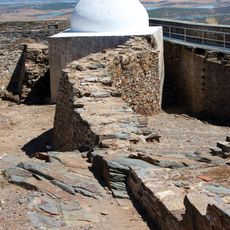
Castelo da Lousa is a submerged Roman fortified farmstead on a schist terrace above the left bank of the original Guadiana, about 2.5 km north of Luz. Its rectangular core building, roughly 19 by 17 m with walls over 2 m thick, blocked a spur only 18 m wide; a central courtyard cistern and a surviving stairway show it was multi-storey. Lower terraces held outbuildings, and the site now lies under the Alqueva reservoir.
The site was occupied between the 1st century BC and the 1st century AD, first in the Iron Age and then in the Roman period. Excavations by Afonso do Paço and Joaquim Bação Leal in the 1960s and 1970s uncovered the two upper platforms on the river side. It was classified as a National Monument in 1970 and later submerged by the Alqueva reservoir, protected by sandbags covered with cement paste.
The name Lousa comes from the stream beside the site, not from the town of Lousã. Excavated finds, including Campana ware, sigillata, loom weights and a bronze coin, are kept in the Museu Regional de Évora, so the objects themselves are seen in the city rather than at the submerged site.
The ruins lie fully submerged in the Alqueva reservoir, about 2.5 km north of Luz and 6 km west-northwest of Mourão, so they cannot be visited on foot. The excavated finds, including coins and Campana ware, are held at the Museu Regional de Évora, where the site's story can be followed.
The site lies submerged in the Alqueva reservoir; before flooding, the walls were protected with sandbags covered in cement paste to limit water erosion. Excavations in the 1960s and a 1984 survey by the German Archaeological Institute recorded the remains.
The community of curious travelers
AroundUs brings together thousands of curated places, local tips, and hidden gems, enriched daily by 94,004 contributors worldwide.