Castro of Zambujal, Prehistoric hillfort in Santa Maria do Castelo e São Miguel, Portugal
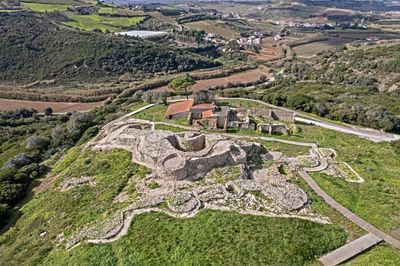
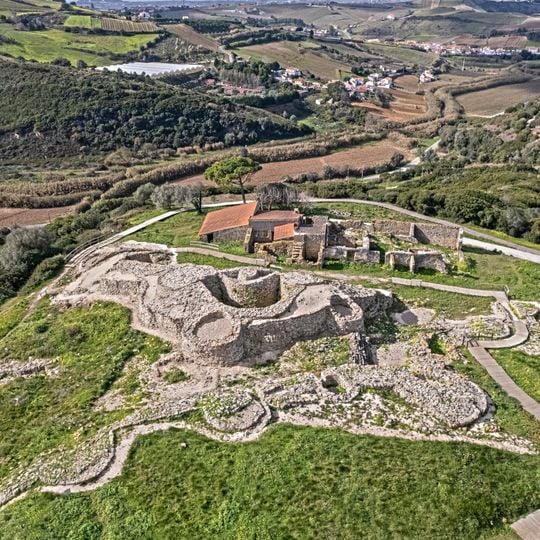
Castro of Zambujal is a Chalcolithic walled settlement on a platform of the Serra do Varatojo, about 3 km from Torres Vedras, above the Sizandro River. Its rough limestone walls enclose a central area of roughly 50 m, reinforced by solid circular and semi-circular towers 5 to 10 m thick; some walls still stand up to 4 m high. The houses inside were oval, about 6 m across, built of adobe.
Occupied from the early 3rd millennium BC, Zambujal was built in successive phases: straight narrow walls, then reinforced gateways, small semicircular towers, large semicircular towers, free-form slab walls with projecting barbicans, and finally hollow towers roofed with cupolas. Around 1700 BC the settlement was partly destroyed, and a rural adobe farmhouse, the Casal do Zambujal, was later built over the central structures. Portugal classified it as a National Monument in 1946.
Zambujal gave its name to the Bell Beaker pottery found here, among the oldest traces of a style that later spread across Europe. The central enclosure, about 50 m across, is thought to have housed higher-status residents and the metalworking and trade goods, while most people farmed and herded on the surrounding land. Finds are kept in the Leonel Trindade Municipal Museum in Torres Vedras.
The site sits on elevated terrain and requires some walking to explore the different areas and defensive sections. Visitors should wear comfortable footwear and allow time to navigate the scattered structures and observe the layout from various vantage points.
The inner enclosure measures about 50 metres across, and its bastions are 5 to 10 metres thick; some walls still stand 4 metres high. Portuguese archaeologist Leonel Trindade identified the site in 1932, and most finds are kept in the Leonel Trindade Municipal Museum in Torres Vedras.
The community of curious travelers
AroundUs brings together thousands of curated places, local tips, and hidden gems, enriched daily by 93,155 contributors worldwide.