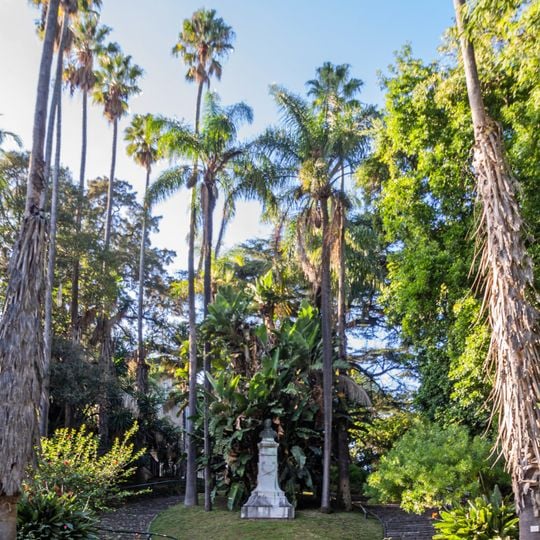
Jardim Botânico de Lisboa, Botanical garden and national monument in Santo António, Portugal.
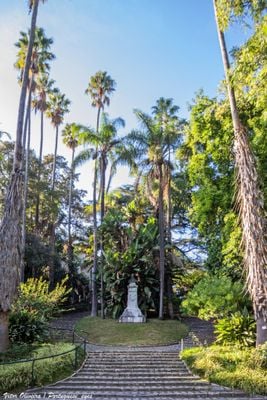
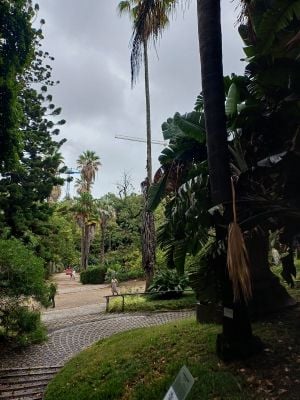
The Jardim Botânico de Lisboa is a four-hectare botanical garden and national monument in Santo António. It holds 1,500 living plant accessions across 50 cultivated taxa, with notable collections of Cycadaceae, Palmae, Gymnospermae and Moraceae, including Ficus. The garden is laid out on the slope of Monte Olivete, with an upper section of dicotyledons and gymnosperms and a lower section of monocotyledons along the Alameda das Palmeiras.
In 1859 the polytechnic school chose a site on Monte Olivete for a practical garden; construction began in 1873 under professors Francisco Manuel de Melo Breyner and João de Andrade Corvo. German gardener Edmond Goeze laid out the upper section, and from 1876 French botanist Jules Daveau developed the lower section with the Alameda das Palmeiras and a stream-and-cascade irrigation system. The garden opened in 1878 and was classified a national monument in 2010.
The garden's name honours its home in the Escola Politécnica quarter, on the slope of Monte Olivete between Rato and Bairro Alto. Its systematic beds were laid out to show plant families to students and the public, and the cycad collection is among its signatures. The Alameda das Palmeiras, the palm avenue traced by Jules Daveau, remains a landmark of the lower garden.
The garden is located near Rato metro station and is open daily, with visiting hours varying depending on the season. It is advisable to wear comfortable shoes, as exploring the site involves considerable walking through different planted areas with varying elevations.
The garden's cycad collection is a living counterpart to extinct fossil floras; some species now survive only in botanical gardens. The German gardener Edmund Goeze and the French botanist Jules Daveau gathered plants from across the Portuguese world for the site.
The community of curious travelers
AroundUs brings together thousands of curated places, local tips, and hidden gems, enriched daily by 93,469 contributors worldwide.