Funa Fortress, Medieval fortress in Luchiste, Ukraine.
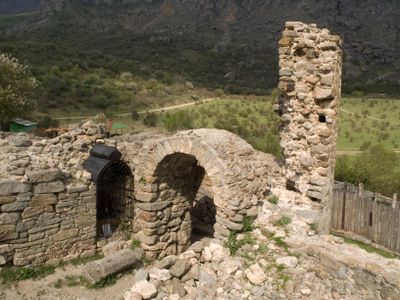
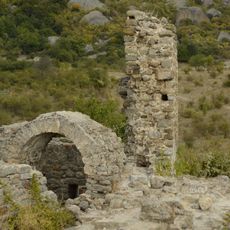
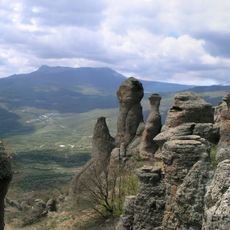
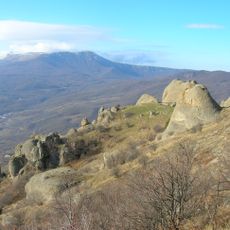
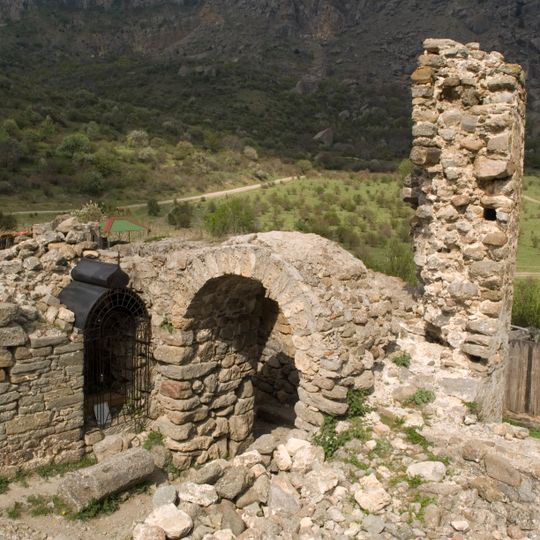
Funa Fortress occupies a rocky hill 2 km north of Luchiste, at the western foot of Mount South Demerdzhi. Its walls enclose 0.52 ha, measuring 106 m north to south and 56 m west to east. The ruins include a tall arched gate with an iron grille, a large wedge-stone archway, and a freestanding tower fragment pierced by one small square hole.
Funa is first documented in patriarchal acts of 1377–1390 as a disputed parish between the metropolitans of Cherson, Gothia and Sugdea. Archaeologist V. P. Kirilko dates the fortification to spring–summer 1423; it was wrecked by an earthquake that October–November and rebuilt around 1425. After a fire, it was thoroughly reconstructed in 1459 into a castle with a 15 m three-tier donjon, then destroyed by the Ottomans in 1475.
The name Funa comes from the Greek word for "smoky", the old name of Mount Demerdzhi; the Genoese called the place Fonna. A local legend holds that a Gothic queen is buried here with a golden crown, a tale not confirmed by excavations. The church of St Theodore Stratelates, the best-preserved building after 1475, was still recorded in church records of 1836.
The site sits on elevated ground, so visitors should expect uneven paths and wear suitable footwear for walking among the stones. It is best to explore during good visibility, and checking ahead about access conditions and any guided visits is worthwhile.
A Gothic queen is said to be buried nearby with a solid-gold crown in her grave. German troops dug for it after occupying Crimea and found nothing, yet locals still hold that the crown lies somewhere beneath the castle walls.
The community of curious travelers
AroundUs brings together thousands of curated places, local tips, and hidden gems, enriched daily by 94,226 contributors worldwide.